1. The End of an Era — Tim Cook’s Final Keynote
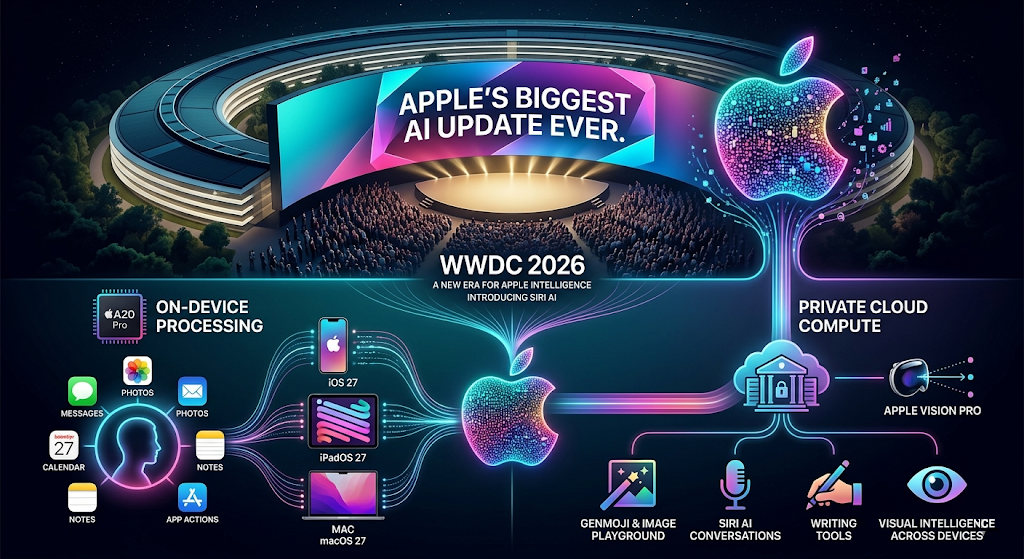
On June 8, 2026, Tim Cook stepped onto the stage at Apple Park in Cupertino, California, for what would be his final WWDC keynote as CEO of Apple.
The moment was historic for two reasons. WWDC 2026 delivered what many analysts consider Apple’s most ambitious AI announcement to date — a ground-up reinvention of Siri, major advancements across iOS, iPadOS, and macOS, and a significant expansion of Apple Intelligence. At the same time, it marked the public farewell of a leader who, over 15 years, guided Apple from a company valued at roughly $350 billion to one approaching the $4 trillion mark.
According to Apple’s official Newsroom announcement on April 20, 2026, Cook will step down as CEO on September 1, 2026, and transition to the role of Executive Chairman. John Ternus, Apple’s Senior Vice President of Hardware Engineering, will assume the position of Chief Executive Officer following what Apple described as a “thoughtful, long-term succession planning process” approved unanimously by the Board of Directors.
In his farewell remarks to the developer community, Cook reflected on Apple’s journey and future:
“Over the years, you have helped people connect, create, learn, and experience the world in extraordinary new ways. I truly believe the best is still ahead at Apple. Getting the best products in the world to deliver experiences that enrich people’s lives has always been our North Star. It’s been the honor of a lifetime.”
Notably, Ternus did not appear during the keynote, leaving the focus squarely on Cook’s final chapter as CEO. Yet the direction of the post-Cook era was evident throughout the presentation, with artificial intelligence, platform integration, and long-term ecosystem strategy emerging as the defining themes of Apple’s next generation.
2. Why WWDC 2026 Is Different From Every WWDC Before It
Apple has hosted the Worldwide Developers Conference annually since 1987. Traditionally, WWDC serves as a showcase for software updates, developer tools, and, on occasion, new hardware. While these announcements often shape Apple’s ecosystem for years to come, only a handful of WWDC events have fundamentally altered the company’s strategic direction.
WWDC 2026 belongs in that category.
For much of the past two years, Apple has been viewed as a company playing catch-up in artificial intelligence. When Apple Intelligence debuted at WWDC 2024, it introduced a privacy-focused AI framework but arrived without its most anticipated capability: a truly conversational Siri capable of understanding personal context, reasoning across apps, and completing multi-step tasks. At WWDC 2025, Apple’s Senior Vice President of Software Engineering, Craig Federighi, acknowledged the delay, telling developers that the work required additional time to meet Apple’s quality standards.
That delay gave competitors valuable momentum. During the same period, ChatGPT, Google Gemini, Anthropic’s Claude, and Meta AI rapidly expanded their capabilities and established daily usage habits among millions of users. By the time WWDC 2026 arrived, Apple was no longer being compared against traditional smartphone competitors—it was being measured against the leading AI platforms in the industry.
WWDC 2026 represents Apple’s response.
In Apple’s official Newsroom announcement, Federighi described the scale of the company’s ambitions:
“We’re delivering the next generation of Apple Intelligence across our platforms; introducing Siri AI, a profoundly more intelligent, knowledgeable, and capable Siri; expanding child safety features with intuitive new tools for families; and making our software platforms faster, more reliable, and more delightful than ever before.”
What sets WWDC 2026 apart is not simply the number of announcements—although more than 40 updates across six platforms is notable. The real difference is strategic clarity. For the first time, Apple has clearly articulated how it intends to compete in the AI era, revealing a vision that extends far beyond a smarter voice assistant and positions artificial intelligence at the center of its future ecosystem strategy.
3. Siri AI — Apple’s Long-Awaited Conversational Assistant Has Arrived
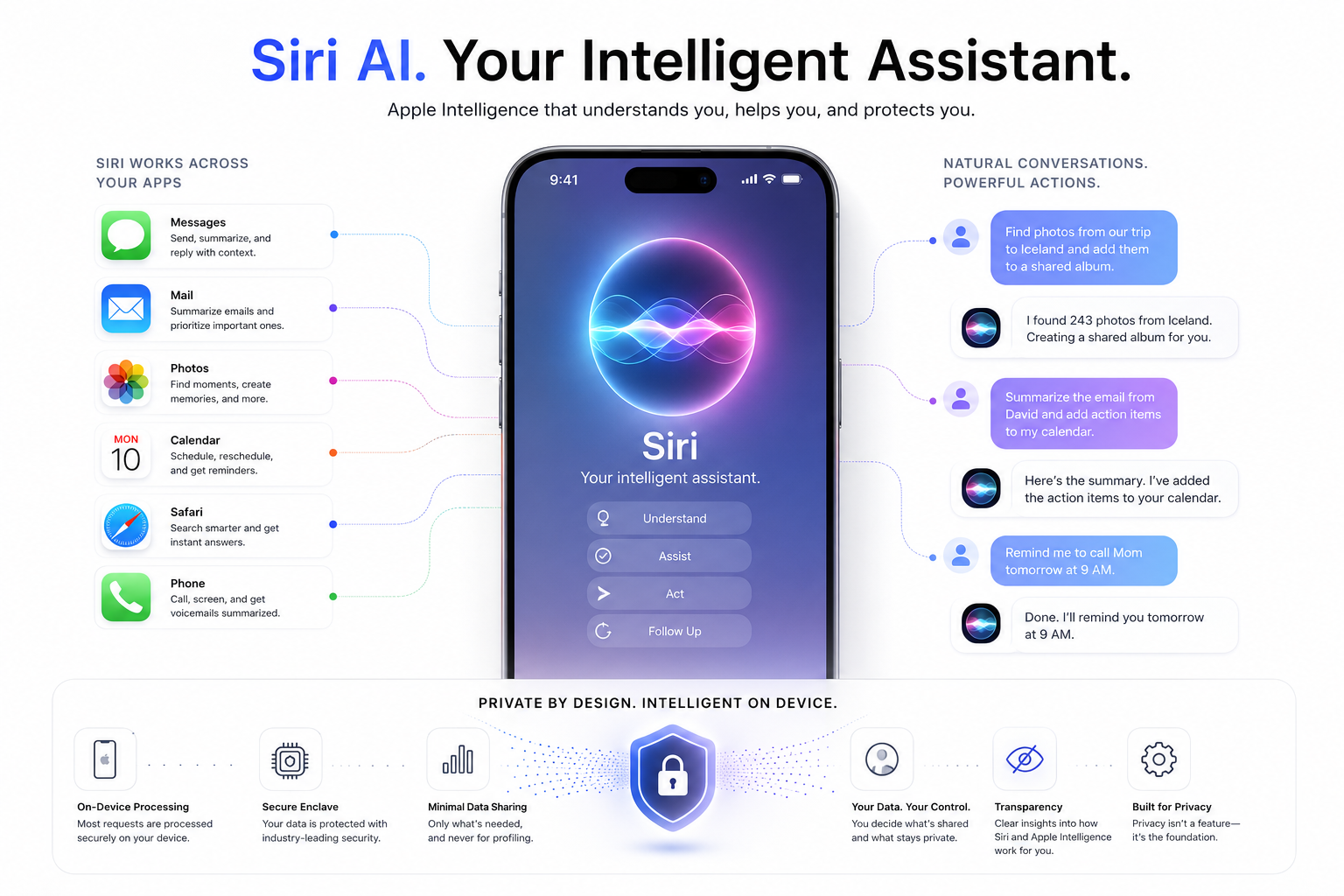
The headline announcement of WWDC 2026 is Siri AI — a complete, ground-up rebuild of the voice assistant Apple first introduced in 2011.
Mike Rockwell, Apple’s Vice President of Siri Engineering, outlined the vision during the keynote:
“We’ve rebuilt Siri with powerful AI at the core, and today we’re introducing an entirely new version of Siri. We call it Siri AI.”
According to Apple’s announcements and subsequent press briefings reported by outlets including Tom’s Guide and Engadget, Siri AI represents Apple’s most significant leap in conversational computing to date.
What Siri AI Can Actually Do
Conversational interactions:
Siri AI maintains conversation history, supports follow-up questions, and delivers more detailed, context-aware responses. The result is an assistant that behaves less like a voice-command tool and more like a conversational partner.
On-screen awareness:
Siri can understand and act on information currently displayed on a device’s screen without requiring users to copy, paste, or switch between apps. During the keynote, Apple demonstrated Siri identifying a landmark shown in an Instagram photo and providing directions in real time.
Personal context across apps:
With user permission, Siri AI can access information from Messages, Mail, Photos, Calendar, and other Apple services to provide personalized assistance. One demonstration showed Siri reviewing multiple text conversations to determine who was bringing items to a potluck, then suggesting beverage pairings through Apple’s World Knowledge Service—all within a single interaction.
More natural voice controls:
Apple has introduced adjustable voice pacing and expressiveness, creating a more natural conversational experience than previous Siri generations.
Dedicated Siri app:
iOS 27 introduces the first standalone Siri app, allowing users to revisit previous conversations and continue unfinished interactions. Explaining the decision, Craig Federighi noted that users often want to return to earlier conversations rather than start over each time.
Privacy — Apple’s Core Argument
Throughout WWDC 2026, Apple positioned privacy as Siri AI’s primary differentiator.
Craig Federighi emphasized the company’s approach during the keynote:
“We believe privacy in AI is non-negotiable. Data is only used to execute your request, and outside experts can continue to verify this promise at any time.”
Mike Rockwell reinforced that message during Apple’s post-keynote media briefing:
“You are in control of your information, your preferences, and your personal context. You’re not going to see an ad from us because we noticed you like Thai food. You stay completely in control of your information at all times.”
From a technical perspective, Apple’s AI architecture operates across two layers:
On-Device Models (Apple Foundation Models):
Most personal requests are processed directly on the device, ensuring sensitive information never leaves the iPhone, iPad, or Mac.
Private Cloud Compute (PCC):
More demanding requests are handled through Apple’s Private Cloud Compute infrastructure, where Apple controls both hardware and software. The company states that requests are not retained after processing and that the system remains open to independent security audits.
What Siri AI Does Not Include — Yet
Just as important as what Apple announced is what it did not announce.
The company has not disclosed specific daily usage limits, potential AI-related iCloud+ pricing tiers, or a complete device compatibility matrix for every Siri AI feature. While Federighi confirmed that certain advanced capabilities—including more expressive voices and enhanced dictation—will be limited to newer hardware, Apple has not yet detailed the exact requirements.
Apple also confirmed that Siri AI will not launch in the European Union initially because of ongoing regulatory considerations. In post-keynote documentation, Apple further clarified that Siri AI functionality on watchOS 27 will face similar regional limitations at launch.
As a result, some aspects of Siri AI’s rollout—including feature availability, hardware requirements, and potential monetization plans—remain questions that Apple is expected to address throughout the beta cycle leading up to the public release of iOS 27.
4. The Google Gemini Partnership — What It Really Means
Perhaps the most consequential revelation of WWDC 2026 was Apple’s confirmation that its new cloud-based AI infrastructure is being developed in collaboration with Google’s Gemini technology.
During the keynote, Apple confirmed that AFM Cloud Pro—the cloud-side layer of its Apple Foundation Models platform—runs on Nvidia-powered infrastructure within Google’s cloud environment. Apple described the service as delivering performance comparable to Gemini Frontier-class models while operating within Apple’s privacy-focused architecture.
The financial terms of the partnership were not disclosed. However, multiple reports from outlets including Bloomberg and MacRumors have described the arrangement as a multi-year licensing agreement potentially worth approximately $1 billion annually and involving a customized Gemini deployment. Apple has not publicly confirmed those figures.
Why Apple Chose a Partner Instead of Building Its Own Model
This decision may become one of the defining technology stories of the decade.
Between 2021 and 2024, Apple invested heavily in artificial intelligence research, acquired multiple AI-focused startups, and developed its own Foundation Models architecture. When Apple Intelligence debuted in 2024, its on-device models demonstrated impressive efficiency and privacy advantages but remained focused on lightweight, device-level workloads rather than competing directly with the largest frontier models from OpenAI, Google, or Anthropic.
Instead of spending several additional years attempting to match those systems, Apple appears to have taken a more pragmatic path: combine its own software, hardware, and privacy infrastructure with best-in-class external AI capabilities.
The strategy allows Apple to focus on its traditional strengths—platform integration, user experience, and ecosystem control—while leveraging advances from leading AI providers.
As one widely cited FourWeekMBA analysis summarized:
“Don’t build the model. Control the two billion devices where the model runs. The distribution is the moat.”
Third-Party AI Extensions in iOS 27
WWDC 2026 also confirmed another significant shift in Apple’s AI strategy. Following earlier reporting from Bloomberg and MacRumors, Apple announced that iOS 27 will support third-party AI providers as Siri extensions, including ChatGPT, Claude, Gemini, Grok, and Microsoft Copilot.
Users will be able to select their preferred AI service through Apple Intelligence & Siri settings, while a dedicated Extensions section will help surface supported providers and integrations.
Explaining the company’s approach, Craig Federighi stated:
“We see Siri not as a separate chatbot, an unintegrated place you go and chitchat, but rather as an integral but conversational tool that you use in the moment. It’s deeply integrated into your experience, understanding what’s on screen.”
That statement reveals a broader strategy that extends beyond Siri itself. Apple is not simply trying to build a more capable assistant. It is positioning the iPhone, iPad, and Mac as the primary interface through which users interact with AI—regardless of which model powers the experience.
In other words, while OpenAI, Google, Anthropic, and others compete to build the most capable models, Apple is focused on controlling the platform, the user experience, and ultimately the distribution layer connecting billions of users to those models.
5. iOS 27 — Every AI Feature Coming to Your iPhone
Beyond Siri AI, iOS 27 introduces the most comprehensive collection of AI-powered features Apple has ever delivered in a single software release. While Siri remains the headline attraction, many of the platform’s most significant advancements are woven directly into everyday iPhone experiences.
Device Compatibility
Apple confirmed that iOS 27 supports iPhone 11 and newer devices, maintaining the same compatibility range as iOS 26. No existing supported iPhone models were removed from the update list.
However, Apple Intelligence features continue to require newer hardware. During WWDC 2026, Craig Federighi confirmed that certain advanced capabilities—including more expressive Siri voices and enhanced dictation—will be limited to higher-performance devices equipped to handle more demanding AI workloads.
Performance Gains (Apple-Confirmed)
According to Apple’s official testing conducted between April and May 2026, iOS 27 also delivers meaningful performance improvements across core system experiences.
| Feature | Speed Improvement |
|---|---|
| Photo loading | Up to 70% faster |
| AirDrop transfers | Up to 80% faster |
| Mail message loading | Up to 80% faster |
| Apple Music playback start | Up to 80% faster |
While these upgrades are not directly tied to Apple Intelligence, they reinforce Apple’s broader effort to improve responsiveness across the ecosystem.
Spatial Reframing — The Photo Feature That Changes Everything
Among the new Apple Intelligence capabilities, Spatial Reframing emerged as one of the most widely discussed features of WWDC 2026.
The tool allows users to adjust the perspective and composition of a photo after it has been captured, effectively recreating the experience of repositioning the camera at the moment the image was taken.
How it works:
- Open a photo in the Photos app
- Tap the new Reframe button
- Adjust the perspective and composition
- Apple Intelligence generates any missing visual elements while preserving the image’s lighting, texture, and style
During Apple’s demonstrations, executives showcased the feature by repositioning subjects within existing photographs while maintaining realistic scene continuity. Notably, Apple also demonstrated Spatial Reframing working with images captured on non-Apple cameras, expanding its appeal beyond the iPhone ecosystem and into professional photography workflows.
Privacy: Apple confirmed that more complex Spatial Reframing requests may leverage Private Cloud Compute. Images are processed within Apple’s privacy architecture and are not retained after the request is completed.
The Extend Tool and Upgraded Cleanup
iOS 27 also introduces two notable enhancements to photo editing.
Extend:
Extend allows users to expand the boundaries of an image by generating additional visual content around its edges. This is particularly useful for changing aspect ratios, recovering composition after cropping, or creating additional space around a subject while preserving the image’s original style.
Cleanup (Enhanced):
Apple’s existing object-removal tool receives a substantial upgrade, with improved contextual understanding, more accurate edge detection, and better handling of crowded or visually complex scenes.
AI-Powered Shortcuts
One of the most practical yet underappreciated additions in iOS 27 is AI-assisted automation within the Shortcuts app.
Instead of manually building workflows step by step, users can simply describe what they want to accomplish in natural language. Siri AI then generates the Shortcut automatically, making automation significantly more accessible to mainstream users who may have previously found the system intimidating.
Systemwide Dictation
Apple has also rebuilt Dictation as a deeper part of the iOS experience.
Integrated directly into the system keyboard, the updated feature automatically handles spelling corrections, punctuation, capitalization, and formatting while working consistently across supported applications. The result is a faster and more natural voice-input experience that requires far less manual editing than previous generations.
6. AI in Safari, Messages, Mail, and Photos
Beyond Siri AI, Apple is integrating Apple Intelligence directly into the applications millions of users rely on every day. Rather than treating AI as a standalone destination, iOS 27 and macOS Golden Gate embed intelligent assistance throughout Safari, Messages, Mail, Phone, Calendar, and other core experiences.
Safari
Safari receives several AI-powered enhancements designed to simplify research, browsing, and workflow management.
AI Tab Grouping:
Safari can automatically organize open tabs based on topics, projects, or browsing intent, helping users manage large numbers of active tabs more efficiently.
Page Monitoring:
A new “Monitor This Page” feature alerts users when a webpage changes, making it useful for tracking breaking news, product availability, event registrations, or research updates.
Describe an Extension:
One of the more distinctive additions allows users to describe a browser extension in natural language. Safari then generates the extension automatically. Several early reviews, including coverage from TechCrunch, highlighted this as one of the most innovative and underreported announcements from WWDC 2026.
Messages and FaceTime
Apple Intelligence is also becoming a deeper part of everyday communication.
Context-Aware Replies:
Suggested responses can now take conversation history into account, producing recommendations that feel more relevant and natural.
Tone-Matching Writing Assistance:
Apple Intelligence can adapt writing suggestions based on context, helping users communicate differently with colleagues, clients, friends, or family members.
Expanded Communication Safety:
Apple has broadened Communication Safety protections to identify and restrict graphic violence and gore in shared content, extending safeguards beyond earlier child-safety-focused implementations.
Mail receives a series of productivity-focused AI upgrades.
Writing and Proofreading Assistance:
Apple Intelligence can help draft, revise, and refine emails directly within the compose window.
Thread Summaries:
Long email conversations can be condensed into concise summaries, making it easier to understand key discussion points without reading every message.
Credential Updates:
Integration with the Passwords app enables one-tap credential updates when login information changes.
Phone
Apple is bringing contextual intelligence into live phone conversations.
During calls, the Phone app can surface relevant information from Messages, Mail, and other approved sources. For example, if a contact previously emailed an address or meeting location, that information can appear automatically while the conversation is taking place.
Calendar
Calendar gains natural-language event creation powered by Apple Intelligence.
Rather than manually entering details, users can simply describe an event in everyday language. Calendar can then interpret the request and automatically populate dates, times, locations, invitees, and other relevant information.
Taken together, these updates reveal a broader pattern across Apple’s software ecosystem. The company’s AI strategy is not limited to building a smarter assistant—it is focused on making every major app more context-aware, proactive, and useful without requiring users to change how they work.
7. macOS Golden Gate — The Intel Era Is Over
Apple’s next Mac operating system carries a name as significant as the transition it completes: macOS Golden Gate.
The name continues Apple’s long-standing tradition of using iconic California landmarks for macOS releases. Yet the most important aspect of Golden Gate is not what it introduces, but what it leaves behind. For the first time, a major macOS release is exclusively designed for Apple Silicon, ending support for Intel-based Macs and marking the final chapter of Apple’s multi-year platform transition.
That transition began in November 2020 with the introduction of the M1 chip. Nearly six years later, Apple has fully aligned its hardware and software roadmap around its own silicon architecture. The result is not only improved efficiency and performance, but also the ability to deliver deeper AI integration powered by Apple’s Neural Engine and on-device machine learning capabilities.
Key macOS Golden Gate Features
| Area | Change |
|---|---|
| Intel Support | Dropped — Apple Silicon only |
| Siri AI | System-wide integration across compatible Macs |
| Liquid Glass UI | New user-adjustable opacity controls |
| Toolbars | Unified design across applications |
| Sidebars | Extended edge-to-edge layout |
| Window Design | Refined corner radius and visual consistency |
| Performance | Up to 80% faster AirDrop, Mail, and Apple Music operations |
| AFM Cloud Pro | Cloud-based AI infrastructure powered through Google’s platform |
Beyond the visual refinements, Golden Gate serves as the Mac’s entry point into Apple’s broader AI ecosystem. Siri AI is deeply integrated throughout the operating system, while Apple Intelligence features become more tightly connected to productivity, communication, and creative workflows.
Apple also confirmed that AFM Cloud Pro—the cloud-side layer of its AI platform—runs on Nvidia Confidential Compute infrastructure within Google’s cloud environment. The announcement is notable because it represents one of the clearest examples of Apple relying on external cloud infrastructure to extend the capabilities of its otherwise privacy-focused AI architecture.
Release Timeline
Developer betas became available immediately following the WWDC 2026 keynote on June 8. Apple plans to launch public betas in July, with a full consumer release expected alongside its next generation of iPhone hardware later this year.
More broadly, macOS Golden Gate symbolizes the completion of Apple’s post-Intel era. With every supported Mac now running on Apple Silicon, the company can optimize future software releases around a single architecture—a move that strengthens performance, simplifies development, and provides the foundation required for the next generation of Apple Intelligence features.
8. Apple’s Real AI Strategy — The One Most Analysts Are Missing
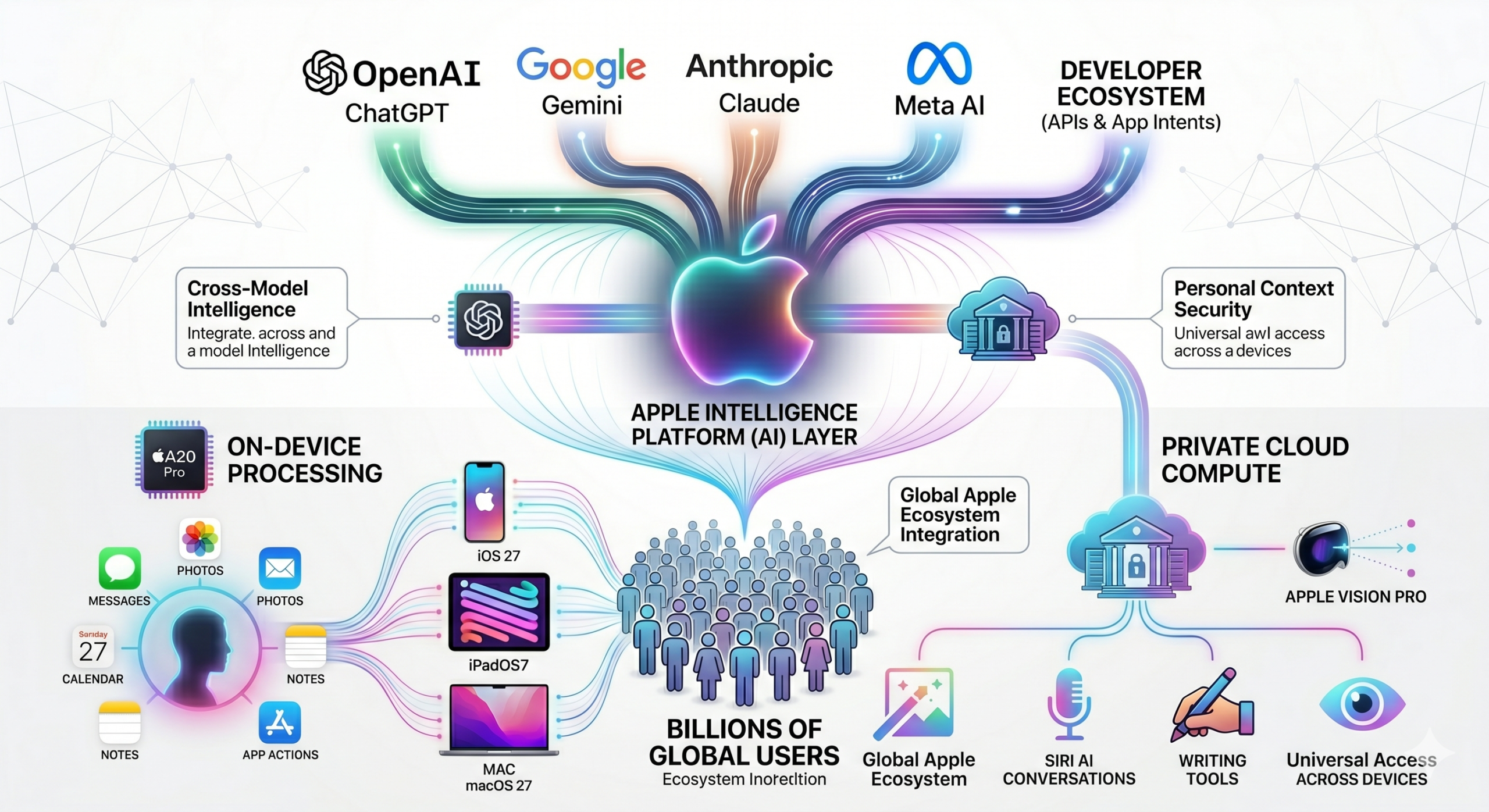
Much of the discussion surrounding WWDC 2026 has focused on a straightforward question: Is Apple’s new Siri finally capable of competing with ChatGPT, Gemini, and other leading AI assistants?
Important as that question may be, it risks overlooking the bigger story.
Apple’s strategy does not appear to be centered on building the world’s most powerful AI model. Instead, the company is positioning itself to become the platform through which users access AI—regardless of which model ultimately wins the race.
Consider what Apple revealed at WWDC 2026:
- Siri AI relies on Google’s Gemini technology for certain cloud-based capabilities
- iOS 27 allows users to choose providers such as ChatGPT, Claude, Gemini, and Grok through Siri integrations
- Developers can build AI-powered experiences using Apple’s on-device Foundation Models at no additional inference cost
- App Intents replaces SiriKit as the primary framework for third-party AI integration
Viewed together, these announcements suggest a strategy that extends beyond Siri itself. Apple is not necessarily trying to replace OpenAI, Google, or Anthropic. Instead, it is creating the environment through which those services reach users while maintaining control over the interface, the operating system, and the overall user experience.
There is a clear historical parallel. Apple did not create Spotify, Instagram, Uber, or countless other successful apps. It built the App Store—the distribution layer that connected those services to hundreds of millions of users. Its AI strategy increasingly appears to follow a similar model.
As one FourWeekMBA analysis observed:
“OpenAI built GPT. Anthropic built Claude. Google built Gemini. Every major tech company decided that owning a frontier AI model was strategically essential. Apple chose the opposite.”
Not everyone agrees that this approach guarantees success. Analysts at PYMNTS framed the central debate differently, asking whether Apple’s AI strategy represents a long-term platform advantage or simply postpones a more difficult competitive challenge.
In that view, the real question is not whether Siri AI is better than ChatGPT today. It is whether Apple can remain the primary gateway to AI interactions if the industry’s most advanced models continue to be developed elsewhere.
Craig Federighi appeared to address that criticism directly during the WWDC keynote, contrasting Apple’s approach with rivals that are, in his words:
“Racing forward, seemingly pursuing AI for the sake of AI, without clear regard to the people — all of us — that it’s ultimately meant to serve.”
Whether Apple’s strategy proves visionary or merely pragmatic remains an open question. What WWDC 2026 made clear, however, is that Apple is approaching the AI era differently from nearly every major competitor. While others are competing to build the best model, Apple is competing to own the platform where those models are used.
And if history is any guide, controlling the platform can be every bit as valuable as controlling the technology itself.
9. How Apple Compares to OpenAI, Google, Anthropic, and Meta
Full Competitive Snapshot
| Dimension | Apple (Siri AI) | OpenAI (ChatGPT) | Google (Gemini) | Anthropic (Claude) | Meta AI |
|---|---|---|---|---|---|
| Core Strength | OS integration, privacy, distribution | Frontier model capability, consumer mindshare | Search dominance, Android ecosystem | Enterprise adoption, safety-focused AI | Massive social platform distribution |
| On-Device AI | Primary strategy | ❌ | ❌ | ❌ | ❌ |
| Privacy Architecture | On-device + Private Cloud Compute | Cloud-based | Cloud-based | Strong enterprise privacy controls | Advertising-driven model |
| Ecosystem Integration | Deep integration across Apple devices | Via apps and integrations | Android, Chrome, Workspace | Limited ecosystem footprint | Facebook, Instagram, WhatsApp |
| Global Reach | 2B+ active Apple devices | Hundreds of millions of users | Billions of Android users | Primarily enterprise and API customers | Billions of social platform users |
| iOS 27 Position | Default assistant | Available through Extensions | Siri partner and Extension option | Available through Extensions | Not integrated |
| AI Hardware Strategy | Apple Silicon ecosystem | No hardware platform | Limited consumer hardware presence | No hardware platform | Ray-Ban Meta smart glasses |
Apple’s Genuine Strengths
Trust and Privacy
Apple continues to differentiate itself through privacy. While competitors primarily rely on cloud-based processing, Apple’s combination of on-device intelligence and Private Cloud Compute allows it to offer advanced AI features while maintaining stronger controls over personal data.
Hardware and Software Integration
Apple controls the entire technology stack—from custom silicon and operating systems to applications and cloud infrastructure. The combination of Apple Silicon, the Neural Engine, and Apple Intelligence creates a level of integration that standalone AI providers cannot easily replicate.
Default Distribution
Perhaps Apple’s greatest advantage is distribution. Siri remains the default assistant across more than two billion active Apple devices, giving the company a direct relationship with users that most AI competitors must acquire through downloads, subscriptions, or partnerships.
Ecosystem Reinforcement
Features such as Foundation Models Framework, App Intents, and Siri AI deepen the connection between developers and Apple’s ecosystem, making Apple Intelligence increasingly embedded within third-party applications and services.
Apple’s Genuine Weaknesses
Model Capability
While Apple’s Foundation Models are optimized for efficiency, privacy, and on-device performance, they are not widely viewed as matching the most advanced frontier models from OpenAI, Google, or Anthropic in raw reasoning and generative capabilities. Apple’s partnership with Gemini highlights that reality.
Slower Iteration Cycles
Apple traditionally updates its platforms through annual software releases. By contrast, OpenAI, Google, and Anthropic deploy new models, features, and improvements continuously throughout the year.
Dependence on Partners
Apple’s cloud-based AI capabilities now rely, at least in part, on external providers. That creates a degree of strategic dependence that competitors such as OpenAI and Google do not face within their own ecosystems.
Regional Availability Challenges
The delayed launch of Siri AI in key markets such as the European Union creates near-term adoption challenges and gives competitors additional time to strengthen their positions.
Why Apple Rejected Meta
One of the more revealing aspects of Apple’s AI strategy is the company’s decision not to pursue a deeper partnership with Meta despite reports that discussions took place.
According to Bloomberg reporting, Apple concluded that providers such as OpenAI, Anthropic, and Google offered stronger AI capabilities while aligning more closely with its long-term product vision. Equally important, Apple’s privacy-focused approach differs fundamentally from Meta’s advertising-driven business model.
The contrast highlights a broader reality of the AI race. While many technology companies are pursuing increasingly powerful models, Apple is prioritizing privacy, ecosystem integration, and user trust. Whether that approach proves to be a competitive advantage or a limitation will be one of the defining questions of the next phase of the AI industry.
10. Business Impact — What WWDC 2026 Means for Apple’s Future
Apple’s Financial Position Entering WWDC 2026
Before evaluating the long-term implications of Apple’s AI strategy, it is important to understand the company’s financial position entering WWDC 2026.
In its fiscal Q2 2026 (March quarter) earnings report, Apple posted:
| Metric | Result | Year-Over-Year Change |
|---|---|---|
| Total revenue | $111.2 billion | +17% |
| iPhone revenue | Approximately $57 billion | +22% |
| Services revenue | $31 billion | +16% |
| Greater China revenue | — | +28% |
These results indicate that Apple is entering the AI era from a position of considerable strength. Unlike many technology companies investing aggressively to establish relevance in artificial intelligence, Apple is deploying AI from an already profitable and mature ecosystem.
The iPhone Upgrade Catalyst
Perhaps the most immediate business impact of WWDC 2026 is its potential to accelerate hardware upgrades.
Apple confirmed that some of Siri AI’s most advanced capabilities—including enhanced voice interactions and advanced dictation features—will require newer hardware. That creates a familiar dynamic within Apple’s business model: users seeking the full experience may ultimately need to upgrade their devices.
Several Wall Street firms, including Goldman Sachs, Wedbush, Morgan Stanley, and JPMorgan, have highlighted AI-driven hardware demand as a potential growth catalyst. Some analysts have even compared the opportunity to previous upgrade cycles driven by major platform transitions such as Face ID and Apple Silicon.
Whether the cycle ultimately reaches “supercycle” status remains uncertain, but WWDC 2026 clearly strengthens Apple’s ability to tie software innovation directly to hardware demand.
Wall Street’s Reaction to WWDC Day
Despite the positive reception to Apple’s AI strategy, investors responded cautiously in the immediate aftermath of the keynote.
AAPL shares declined following the event, a move many analysts described as a classic “sell-the-news” reaction after weeks of anticipation leading into WWDC. Investor concerns centered primarily on execution and timing. Apple did not provide a precise rollout schedule for all Siri AI capabilities, while regional availability limitations—including delayed launches in certain markets—introduced additional uncertainty.
Many analysts, however, argued that the market’s short-term reaction did not fully reflect the longer-term implications of Apple’s AI roadmap. The broader investment thesis remains tied to what happens after iOS 27 reaches consumers and becomes integrated into the next hardware refresh cycle.
Services Revenue and the AI Monetization Opportunity
While WWDC 2026 focused primarily on product capabilities, the event also raised important questions about AI monetization.
Apple confirmed that core Siri AI functionality will be available to users, but the company did not disclose detailed pricing structures, usage limits, or long-term monetization plans for cloud-based AI services.
As a result, industry analysts have increasingly speculated that Apple could eventually introduce premium Apple Intelligence tiers, expanded iCloud+ integrations, or other subscription-based offerings designed to offset the infrastructure costs associated with advanced AI services. At this stage, however, such offerings remain analyst expectations rather than announced products.
Antitrust Risk
One area likely to attract regulatory attention is the growing relationship between Apple and Google.
Apple already maintains a substantial commercial partnership with Google through Safari’s default search arrangement. The addition of AI-related collaboration introduces another layer to that relationship and may attract scrutiny from regulators in the United States, Europe, and other jurisdictions where both companies are already facing antitrust investigations.
While no immediate regulatory action has been announced, investors will likely continue monitoring how policymakers view the increasing concentration of influence among the largest technology platforms.
Developer Economics
For developers, WWDC 2026 creates both opportunities and challenges.
The Foundation Models Framework provides free access to Apple’s on-device AI capabilities, allowing developers to integrate intelligent features without paying ongoing cloud inference costs. This lowers barriers to entry and could encourage broader adoption across smaller development teams and independent software vendors.
At the same time, Apple’s transition from SiriKit to App Intents introduces migration costs. Applications that rely heavily on Siri integrations will need to adapt to the new framework over time, creating additional development work—particularly for enterprise software providers with complex automation and workflow integrations.
Taken together, Apple’s AI strategy is designed to strengthen three of its most important businesses simultaneously: hardware, services, and the developer ecosystem. The success of that strategy will ultimately determine whether WWDC 2026 becomes remembered as a major product update—or the beginning of Apple’s next growth cycle.
11. The iPhone Upgrade Supercycle, Smart Glasses, and What Comes Next
While WWDC 2026 focused on products and features arriving in the near term, the event also offered clues about Apple’s longer-term hardware roadmap. Some of these signals come from developer software, while others are based on reporting from analysts and supply chain sources. Together, they provide a glimpse into how Apple may be preparing for the next phase of the AI era.
Foldable iPhone — What the Reports Suggest
Although Apple made no foldable iPhone announcement at WWDC 2026, developers and industry observers quickly identified references within the iOS 27 beta that appear designed for new display configurations.
Researchers, including @M1Astra, highlighted references such as “foldState” and “angleDegrees,” which several publications—including TechCrunch—have interpreted as potential groundwork for foldable hardware support.
Separately, reporting from Bloomberg, MacRumors, and multiple supply chain sources suggests Apple is preparing a book-style foldable iPhone that could debut alongside future flagship devices. Reported specifications include a 7.8-inch internal display and a proprietary liquid-metal hinge design.
It is important to note that none of these details have been officially confirmed by Apple.
Apple Smart Glasses — Beyond Vision Pro
Perhaps the most closely watched future product category is smart glasses.
Bloomberg’s Mark Gurman reported in 2026 that Apple’s smart-glasses project, internally known as N50, is targeting a launch window in late 2027. According to those reports, the first-generation device is expected to include cameras, microphones, and speakers while relying heavily on a connected iPhone for processing.
Industry reports suggest the product will initially focus on AI-powered assistance rather than full augmented reality, positioning it closer to Meta’s Ray-Ban smart glasses than to Vision Pro.
The long-term vision appears more ambitious. Several reports indicate Apple is also exploring future AR glasses equipped with advanced display technologies, though such products remain years away from commercial release.
If these reports prove accurate, smart glasses could become one of the most important hardware extensions of Apple Intelligence, bringing Siri AI, Visual Intelligence, navigation, translation, and contextual assistance into a hands-free wearable form factor.
AI-Powered AirPods
Apple’s AI ambitions may extend beyond phones and glasses.
According to industry reporting and coverage from MacRumors, future AirPods models are expected to integrate additional sensors and camera-related technologies that could expand gesture recognition and Visual Intelligence capabilities.
In the shorter term, Apple is already bringing incremental improvements to existing AirPods users through iOS 27, including long-requested audio customization features such as a user-adjustable EQ.
Siri AI Roadmap
While Apple has outlined the initial rollout of Siri AI, several elements of the platform remain works in progress.
| Milestone | Timeline | Status |
|---|---|---|
| Siri AI developer beta | June 2026 | Confirmed |
| iOS 27 public release | September 2026 | Confirmed |
| EU launch | TBD | Delayed |
| China launch | TBD | Regulatory review |
| SiriKit deprecation | TBD | Confirmed direction |
| Premium AI subscription tier | Unannounced | Analyst speculation |
| Apple smart glasses | Late 2027 (reported) | Industry reporting |
What emerges from these developments is a broader pattern. Apple’s AI strategy is increasingly tied to hardware. Whether through future iPhones, wearables, AirPods, or smart glasses, the company’s long-term objective appears to be extending Apple Intelligence beyond the smartphone and into every device that surrounds the user.
If WWDC 2026 marked the beginning of Apple’s AI platform era, the next several years may determine how far that platform can extend beyond the screen.
12. What Could Go Wrong — Apple’s Real AI Risks
No assessment of WWDC 2026 is complete without examining the challenges that could derail Apple’s AI ambitions.
Much of the reaction to the keynote has been positive, and for good reason. Apple unveiled a substantially improved Siri, expanded Apple Intelligence across its ecosystem, and presented a clearer AI strategy than many observers expected. Yet none of those developments guarantee success. The company’s AI roadmap still faces meaningful execution, competitive, and regulatory risks.
Risk 1: Users Don’t Change Existing AI Habits
One of Apple’s biggest challenges may have nothing to do with technology.
By the time Siri AI launches broadly, millions of users will have spent years building habits around ChatGPT, Gemini, Claude, and Perplexity. Those products have become daily tools for research, writing, coding, and problem-solving.
Even with the advantage of being deeply integrated into the iPhone, Siri AI must convince users that changing established behavior is worth the effort. History suggests that user habits can be difficult to break, even when a competing product is available by default.
Risk 2: Dependence on External AI Providers
Apple’s strategy increasingly relies on partnerships as well as internal technology.
The company’s cloud-based AI capabilities now depend, at least in part, on external infrastructure and model providers. If licensing costs increase, partnerships evolve, or access to leading models becomes more restricted, Apple could face strategic limitations that competitors controlling their own frontier models do not.
This challenge is particularly important because Apple has positioned integration and user experience—not raw model leadership—as its primary competitive advantage.
Risk 3: Delayed Availability in Key Markets
Apple confirmed that Siri AI will not launch immediately in some major regions because of regulatory considerations.
The longer those delays persist, the greater the opportunity for competing AI platforms to strengthen their positions. Users who become accustomed to alternative assistants may be less likely to switch later, even if Apple’s offering eventually becomes available.
For a company that relies heavily on ecosystem loyalty, regional gaps create a meaningful adoption risk.
Risk 4: The Hardware Divide
Many of Siri AI’s most advanced capabilities require newer Apple devices.
As a result, a significant portion of the installed iPhone base may experience a more limited version of Apple’s AI vision than what was demonstrated during the keynote. Managing expectations will be critical.
Apple faced similar criticism during earlier Apple Intelligence rollouts when certain headline features were restricted to newer hardware. If consumers perceive a large gap between marketing and real-world availability, adoption could be slower than anticipated.
Risk 5: Regulatory and Antitrust Pressure
Apple’s expanding AI relationship with Google introduces additional regulatory complexity.
Both companies are already facing antitrust scrutiny in multiple jurisdictions. Future rulings, restrictions, or regulatory remedies could affect how the partnership operates and potentially force changes to commercial agreements tied to search, AI services, or platform integrations.
While no such outcome is guaranteed, regulators are likely to pay close attention to any arrangement that further concentrates influence among the world’s largest technology companies.
Risk 6: Developer Adoption Takes Longer Than Expected
Apple’s AI strategy depends heavily on developer participation.
The transition from SiriKit to App Intents provides developers with a more modern framework, but it also requires investment. Large software vendors and enterprise developers may need significant time and resources to migrate existing integrations.
If adoption progresses slowly, the rich ecosystem of cross-app actions and intelligent workflows showcased by Apple could take longer to materialize than consumers expect.
The Bigger Risk
Taken individually, none of these challenges are likely to derail Apple’s AI strategy. Collectively, however, they highlight the central question facing the company.
Apple is betting that integration, privacy, and distribution can outweigh the advantage of owning the industry’s most advanced AI models. If that bet succeeds, WWDC 2026 may be remembered as the moment Apple redefined its future. If it fails, critics may argue that the company entered the AI race later than its rivals and never fully closed the gap.
The answer will not be determined by a keynote presentation. It will be determined by how users, developers, and regulators respond over the next several years.
13. Final Verdict — Is Apple Finally an AI Company?
WWDC 2026 answered one of the biggest questions surrounding Apple since the debut of Apple Intelligence: the company is capable of delivering a credible, competitive AI experience.
Yet that may not be the most important takeaway from the event.
The more significant question is whether Apple is building the right kind of AI company for the next decade.
While OpenAI, Google, Anthropic, and Meta continue competing to develop the most capable models, Apple appears to be pursuing a different objective. Rather than winning the model race, it is attempting to own the platform through which users access AI—across the iPhone, iPad, Mac, Apple Watch, and future hardware categories still to come.
Whether that strategy proves visionary or vulnerable depends on two factors. The first is whether AI models become increasingly interchangeable over time, making distribution, integration, and user trust more valuable than model ownership. The second is whether a single provider develops such a dominant AI experience that users are willing to leave established ecosystems to access it.
At the moment, the evidence largely supports Apple’s thesis.
Siri AI and iOS 27 represent the most ambitious and coherent AI products Apple has introduced to date. The company’s privacy architecture remains a meaningful differentiator, and its level of ecosystem integration is difficult for standalone AI applications to replicate.
At the same time, important challenges remain. Apple entered the AI race later than several competitors, regional rollout limitations create near-term obstacles, and it remains unclear whether users will significantly change the AI habits they have already developed elsewhere.
Tim Cook’s legacy is that he built a company capable of competing in this moment. The next chapter belongs to John Ternus and the leadership team responsible for turning Apple’s AI vision into a long-term platform advantage.
The real test begins after the keynote ends—when Siri AI reaches consumers, developers begin building on Apple’s frameworks, and competitors continue advancing at extraordinary speed.
As Craig Federighi remarked during WWDC 2026, some companies appear to be:
“Racing forward, seemingly pursuing AI for the sake of AI, without clear regard to the people — all of us — that it’s ultimately meant to serve.”
WWDC 2026 made one thing clear: Apple has finally placed its bet on artificial intelligence. The question now is not whether Apple is an AI company. The question is whether its platform-first approach will define the next era of computing.
The answer will shape not only Apple’s future, but potentially the future of the AI industry itself.
Key Takeaways
| What Apple Confirmed | What Analysts Are Reporting (Not Apple-Confirmed) |
|---|---|
| Siri AI and next-generation conversational experiences | Reported financial terms of the Google Gemini partnership |
| AFM Cloud Pro and expanded Apple Intelligence capabilities | Foldable iPhone launch timing and specifications |
| iOS 27 support for iPhone 11 and newer | Apple smart glasses launch timeline |
| macOS Golden Gate as an Apple Silicon-only release | Future AI subscription products and pricing |
| Tim Cook’s transition and leadership succession plan | Specific hardware requirements for every AI feature |
| Delayed Siri AI availability in certain regions | AI-driven upgrade supercycle projections |
| Foundation Models Framework for developers | Long-term Apple Intelligence monetization plans |
| App Intents as the future of Siri integration | Potential regulatory and antitrust outcomes |
Frequently Asked Questions Answered in This Article
What is Siri AI?
Siri AI is Apple’s next-generation conversational assistant announced at WWDC 2026. Unlike previous versions of Siri, it supports multi-turn conversations, understands on-screen content, accesses personal context with user permission, and can perform more complex multi-step actions across apps.
What did Apple announce at WWDC 2026?
Apple introduced Siri AI, iOS 27, macOS Golden Gate, expanded Apple Intelligence capabilities, AI-powered productivity features, new developer frameworks, photo-editing tools such as Spatial Reframing, and updates across its major software platforms.
What is Apple’s relationship with Google Gemini?
Apple confirmed that parts of its cloud-based AI infrastructure are developed in collaboration with Google’s Gemini technology. While Apple disclosed the partnership, financial terms and several implementation details remain based on industry reporting rather than official company disclosures.
Is Siri AI available in Europe?
No. Apple confirmed that Siri AI will not be available in the European Union at launch because of regulatory considerations. Availability timelines have not yet been finalized.
Which iPhones support Siri AI and Apple Intelligence?
Apple Intelligence requires supported Apple Intelligence-compatible devices. Apple has confirmed that some advanced AI capabilities will require newer hardware, although the company continues to refine compatibility details throughout the beta period.
What is macOS Golden Gate?
macOS Golden Gate is Apple’s 2026 Mac operating system release. It marks the end of Intel Mac support, introduces deeper Apple Intelligence integration, and is optimized exclusively for Apple Silicon devices.
What is Spatial Reframing in iOS 27?
Spatial Reframing is an Apple Intelligence-powered editing feature that allows users to adjust the composition and perspective of a photo after it has been captured. Missing areas are generated to match the original scene’s lighting, texture, and visual style.
What is the Foundation Models Framework?
The Foundation Models Framework is Apple’s developer platform for integrating on-device AI capabilities into third-party applications. It enables developers to build AI-powered experiences while maintaining privacy and reducing dependence on cloud processing.
Who is replacing Tim Cook as Apple CEO?
According to Apple’s official announcements, John Ternus will assume the role of Chief Executive Officer following Tim Cook’s transition to Executive Chairman as part of Apple’s long-term leadership succession plan.
Can I use ChatGPT or Claude with iOS 27?
Yes. Apple announced support for third-party AI integrations through Siri extensions, allowing users to access services such as ChatGPT, Claude, Gemini, and other supported providers within the Apple Intelligence ecosystem.
Sources
Primary Sources
Industry Coverage
Disclosure
Certain financial projections, market forecasts, hardware roadmaps, and future product references discussed in this article are based on analyst commentary, industry reporting, supply-chain sources, and third-party research rather than official Apple announcements.
References to future products including foldable iPhone models, smart glasses initiatives, subscription offerings, and long-term Apple Intelligence monetization plans—should be viewed as reported or projected developments rather than confirmed product announcements.
This article reflects information available as of WWDC 2026 and may be updated as Apple releases additional details during the iOS 27, macOS Golden Gate, and Apple Intelligence beta cycles.