Introduction: The Dawn of Agentic AI
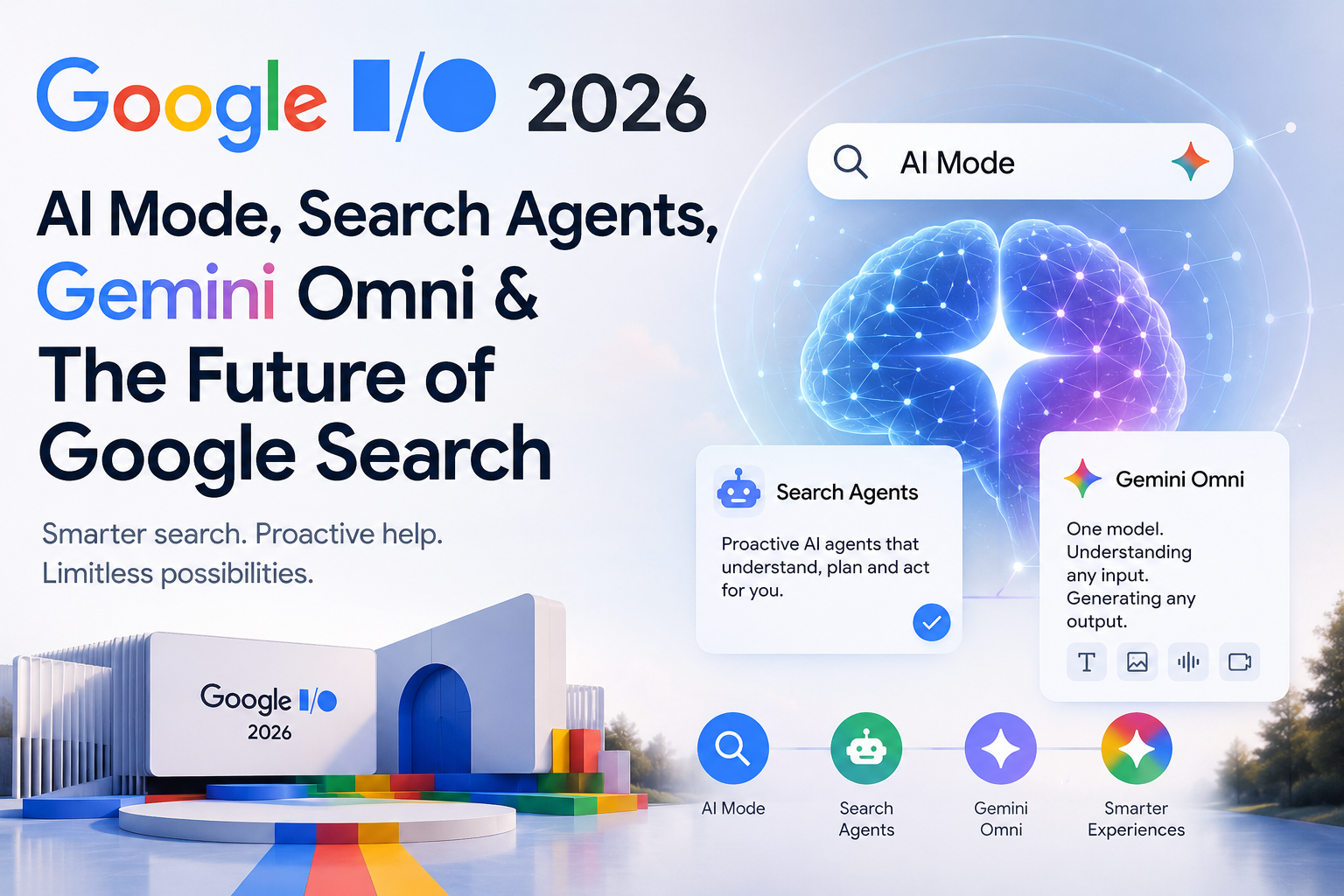
The Google I/O 2026 conference, held on May 19-20, 2026, at the Shoreline Amphitheatre in Mountain View, California, marked a watershed moment in the evolution of artificial intelligence. This wasn’t just another product launch. It was Google’s formal declaration that the era of passive AI assistants is over, and the age of autonomous AI agents has begun.
For nearly three decades, Google Search has been built on a simple exchange: you type a query, Google returns a list of links. That fundamental relationship ended at I/O 2026. In its place, Google unveiled an ecosystem where AI agents work continuously in the background, reason across information, complete complex tasks, and fundamentally reshape how we interact with the internet.
CEO Sundar Pichai opened the keynote with a clear message: “We’ve transitioned from AI that simply assists you, to agents that can independently navigate complex tasks across your entire workflow.” This statement encapsulated the entire event. Every major announcement centered on one theme: agentic AI that works on your behalf, not just when you ask.
The implications extend far beyond technology enthusiasts. For businesses, marketers, SEO professionals, content publishers, and everyday users, Google I/O 2026 introduced changes that will fundamentally alter digital strategy, search optimization, e-commerce, content creation, and how billions of people find information online.
The Star of the Show: Gemini 3.5 Flash
What Makes Gemini 3.5 Flash Revolutionary
Gemini 3.5 Flash represents Google’s answer to the speed versus intelligence trade-off that has plagued AI development. Traditionally, more capable models meant slower responses and higher costs. Gemini 3.5 Flash shatters this paradigm.
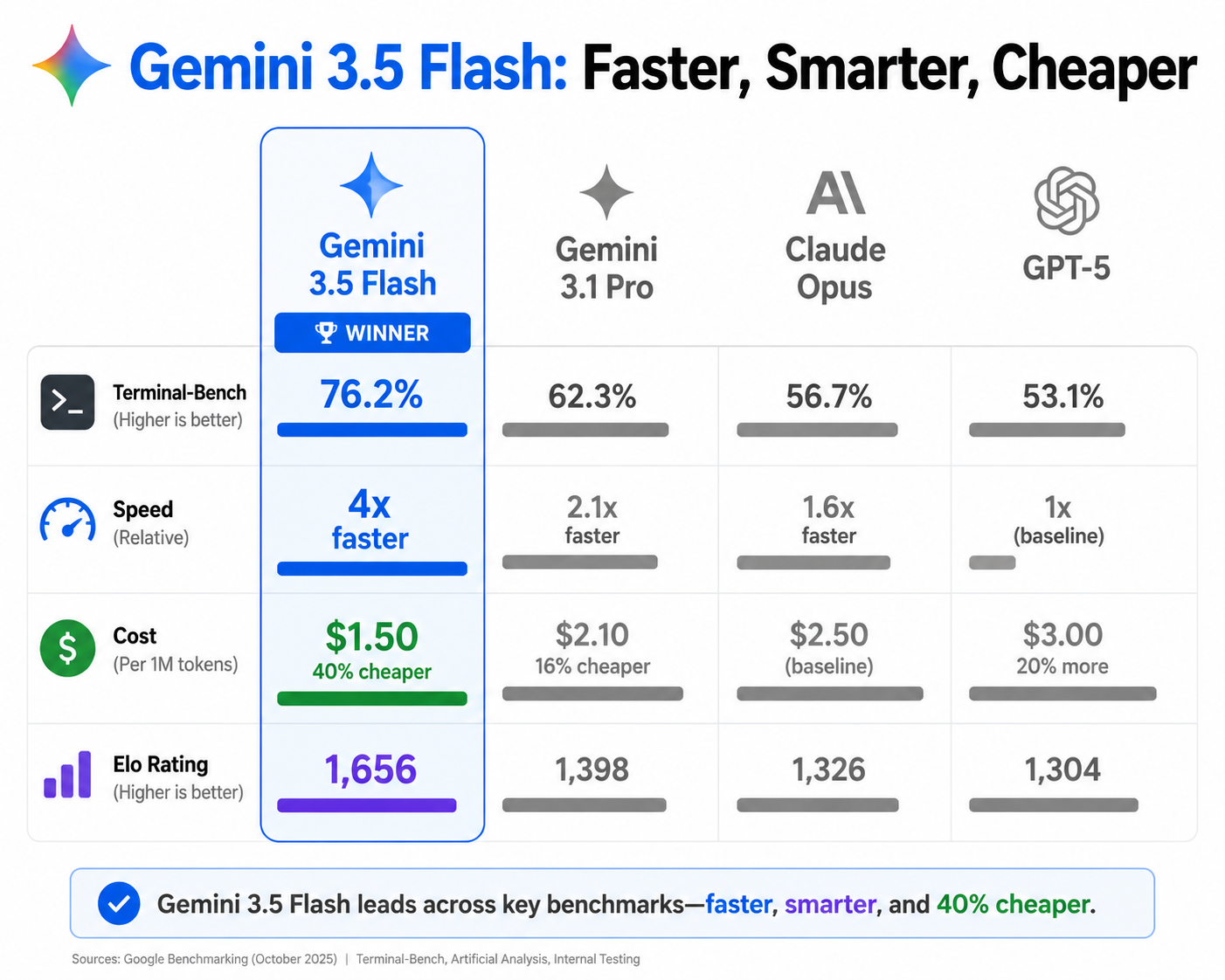
Released on May 19, 2026, as the first model in the Gemini 3.5 family, Flash achieves something remarkable: it outperforms the previous flagship model, Gemini 3.1 Pro, on nearly every benchmark that matters for real-world applications while delivering responses four times faster than competing frontier models.
Key Performance Metrics:
• Terminal-Bench 2.1 (coding): 76.2% (surpassing Gemini 3.1 Pro)
• GDP Val-AA (agentic tasks): 1,656 Elo rating
• MCP Atlas (tool use reliability): 83.6%
• CharXiv Reasoning (multimodal understanding): 84.2%
• Output speed: 4x faster than other frontier models in tokens per second
The economics are equally impressive. At $1.50 per million input tokens and $9 per million output tokens, Gemini 3.5 Flash costs approximately 40% less than Gemini 3.1 Pro while delivering superior performance. Google estimates this could save enterprises more than $1 billion annually in AI infrastructure costs.
Agentic Capabilities and Dynamic Thinking
What truly sets Gemini 3.5 Flash apart is its agentic architecture. Unlike traditional AI models that simply respond to prompts, this model can plan multi-step operations, call external tools, iterate based on results, and execute complex workflows autonomously.
The model features dynamic thinking by default, automatically allocating more computational resources to harder problems. When you ask a simple question, it responds instantly. When you present a complex challenge requiring reasoning across multiple domains, it scales up compute on the fly. This adaptive intelligence means you never overpay for simple tasks or underperform on difficult ones.
Google’s internal usage tells the story. In March 2026, Google’s developers processed roughly half a trillion tokens per day using Gemini models within their Antigravity development platform. By mid-May, that figure surged past three trillion tokens per day. That’s a six-fold increase in approximately ten weeks, with usage doubling every few weeks.
This internal adoption created a powerful feedback loop: the more Google’s own engineers used 3.5 Flash to build products, the more training data and real-world insights fed back into the model’s development. This is the data flywheel effect in action.
Availability and Gemini 3.5 Pro
Gemini 3.5 Flash is available immediately across multiple surfaces: the Gemini app, Google Search, Antigravity 2.0 development platform, Google AI Studio, and the Gemini API. It becomes the default model for billions of users globally.
However, Google held back Gemini 3.5 Pro. Pichai announced on stage that Pro would arrive “next month” (June 2026), a delay that reportedly drew audible groans from the live audience. While Flash excels at speed and agentic tasks, Pro is designed for deep reasoning, long-context understanding, and the most challenging problems. The wait for Pro highlights that even with Flash’s impressive capabilities, certain use cases still require the computational power of a larger model.
Gemini Spark: Your 24/7 Personal AI Agent
What Is Gemini Spark?
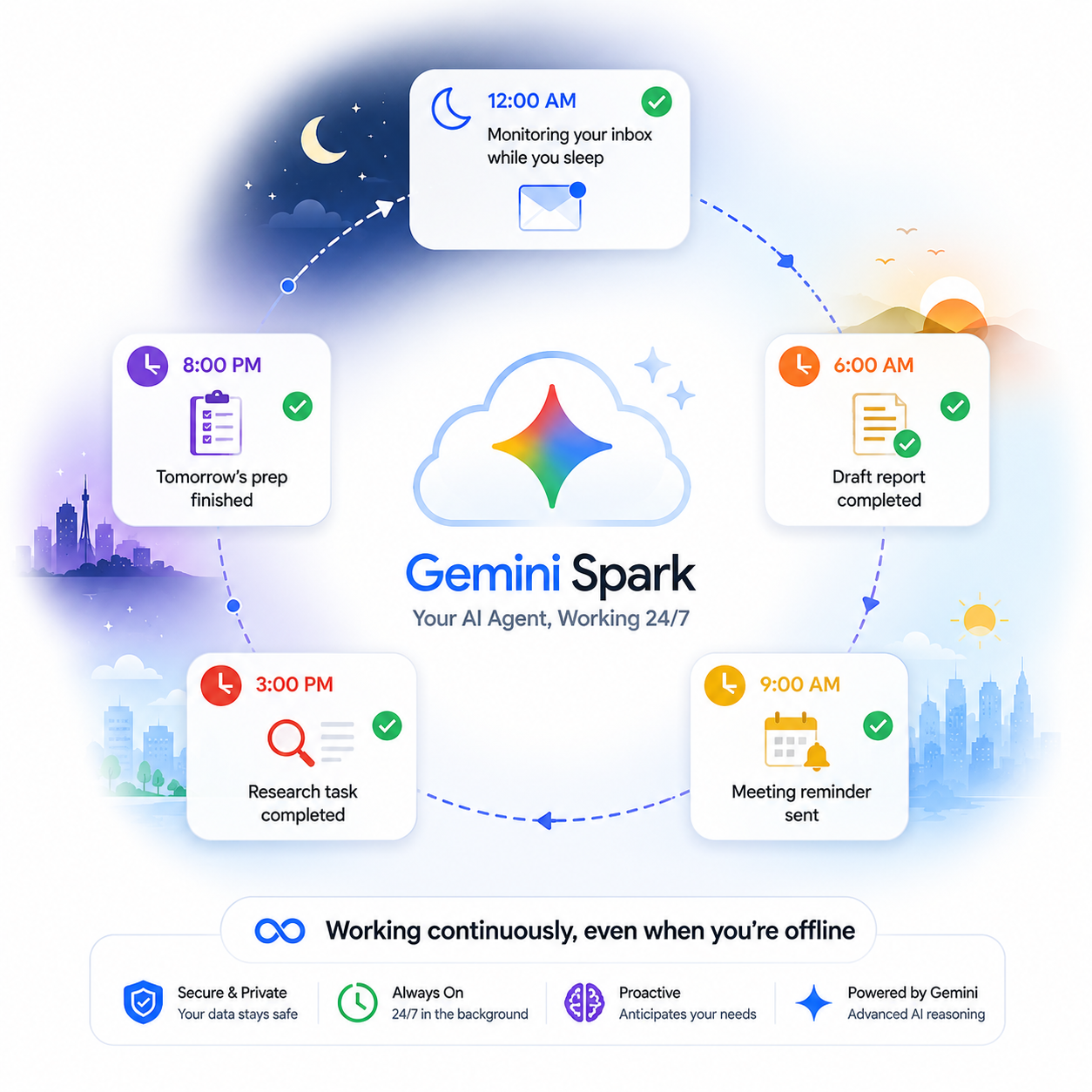
If Gemini 3.5 Flash is the engine, Gemini Spark is the autonomous vehicle. Announced as Google’s first true consumer AI agent, Spark represents a fundamental shift from reactive assistance to proactive action.
Pichai described Spark as “your personal AI agent that helps you navigate your digital life, taking action on your behalf and under your direction.” The key phrase is “under your direction.” You set the parameters, establish the guardrails, and define the goals. Spark then works continuously, even when your devices are off.
Unlike traditional assistants that wait for your prompt, Spark runs on dedicated virtual machines in Google Cloud. It operates 24/7, monitoring your inbox, tracking commitments, managing tasks, and taking action when conditions you’ve specified are met. It’s powered by Gemini 3.5 models and Google’s Antigravity agent orchestration framework.
How Spark Works
Spark integrates first with Google’s own services: Gmail, Google Docs, Google Calendar, and other Workspace apps. Later this summer, support expands to third-party tools through the Model Context Protocol (MCP), enabling Spark to work across the broader software ecosystem.
Example use cases:
- Monitor your inbox so you never miss an important customer inquiry
- Track project deadlines and automatically coordinate with team members
- Draft responses to routine emails while you sleep
- Research topics and compile reports before you even ask
- Coordinate across multiple apps to complete complex workflows
You can interact with Spark through the Gemini app, via email, or through chat. On Android devices, a new UI feature called Android Halo (launching later in 2026) will show live updates and task progress from agents like Spark. By summer, Spark will operate directly within Chrome, acting as an agentic browser across the web.
Pricing and Availability
Gemini Spark launched as part of a new Google AI Ultra tier priced at $100 per month. This premium subscription is designed for developers, creators, and power users who need advanced capabilities and higher usage limits.
The beta rolled out to trusted testers in the week of May 19, 2026, with broader availability to Google AI Ultra subscribers in the United States beginning the following week. Google indicated that Spark will eventually become available to more users as the technology matures, though specific timelines weren’t announced.
Daily Brief: Your Morning Intelligence
Alongside Spark, Google introduced Daily Brief, a personalized morning digest that analyzes your Gmail, Calendar, and Tasks to create a prioritized overview of your day. It surfaces what needs attention, suggests next steps, and helps you start each morning with clarity. Daily Brief rolled out to Google AI Plus, Pro, and Ultra subscribers in the United States starting May 19, 2026.
The Search Revolution: Information Agents and Intelligent Search
The End of the Ten Blue Links
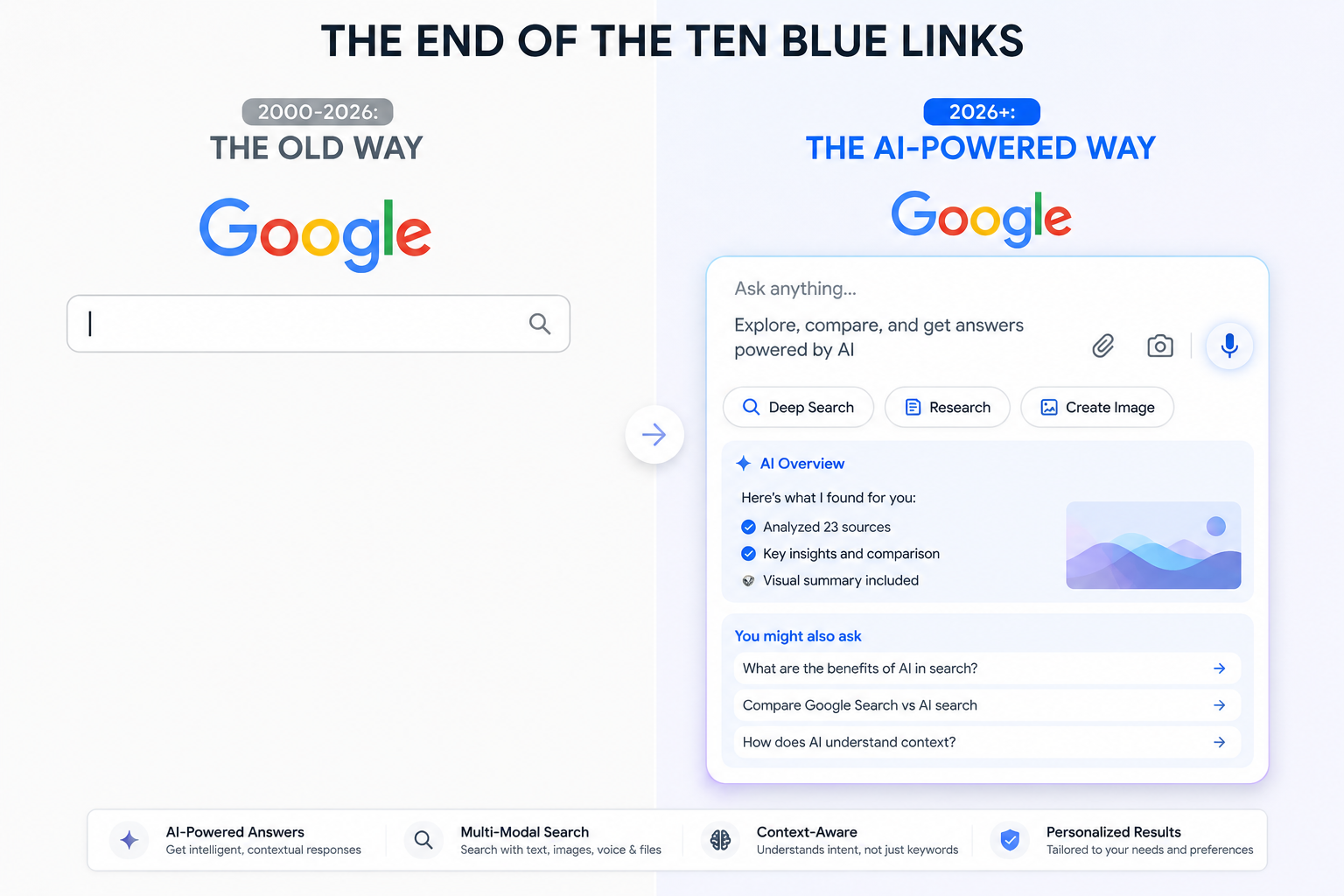
For more than 25 years, Google Search has opened with the same interface: a blank white rectangle and the expectation that you’ll type a handful of keywords. At I/O 2026, Google declared that era over.
Google unveiled the biggest redesign of the search box in its history. The new “intelligent search box” dynamically expands to accommodate longer, more conversational queries. It includes an AI-powered suggestion system that goes beyond traditional autocomplete, attempting to anticipate intent and help users formulate more precise questions.
Most significantly, the search box now accepts multimodal inputs. You can attach files, paste images, or include video clips alongside your text query. The AI analyzes all inputs together to understand what you’re really asking.
This isn’t just a visual refresh. It represents a fundamental change in what search means. Instead of returning a list of links, Google Search increasingly delivers interactive AI-powered experiences, custom-built tools, and agent-driven workflows that complete tasks rather than simply pointing you to information.
Information Agents: Search That Never Stops
The headline feature of Google’s search overhaul is information agents. These are persistent, background AI processes that monitor the web on your behalf, 24/7, and surface relevant findings without being prompted.
Think of Google Alerts, the 2003-era notification tool that emails you when specific keywords appear online. Information agents are that concept rebuilt with frontier AI capabilities. They don’t just match keywords. They reason across blogs, news sites, social media, real-time data on finance and sports, shopping platforms, and the broader web to understand context, synthesize information, and alert you when something meaningful changes.
Example scenarios:
- Apartment hunting: Set your exact requirements (location, budget, amenities, pet policy) and your agent monitors listings, price changes, and availability, alerting you the moment something matches
- Stock market: Track specific companies, industries, or economic trends with an agent that monitors market activity, breaking news, earnings reports, and major price movements
- Sneaker collecting: Never miss a limited-edition drop. Your agent watches your favorite athletes and brands, notifying you instantly when new collaborations are announced
- Research projects: Track academic publications, regulatory changes, or industry developments relevant to your work
Information agents roll out first to Google AI Pro and Ultra subscribers in the United States during summer 2026. You can create, customize, and manage multiple agents directly from Google Search, each focused on different topics or goals.
Generative UI and Mini-Apps
Beyond agents, Google introduced generative UI capabilities in Search. When you ask for help with a complex task, Search can now build custom interactive tools on the fly, tailored to your specific need.
Need to compare mortgage rates across lenders with your specific down payment and credit score? Search generates a calculator. Planning a multi-city trip and need to optimize travel routes? Search creates a trip planner. These aren’t pre-built templates. They’re custom applications generated in natural language based on your query.
The feature rolled out to all U.S. users for free during summer 2026, with premium features (like mini-app building) available first to Pro and Ultra subscribers.
Agentic Booking and Commerce
Google expanded agentic capabilities in Search to handle complex booking scenarios. Share your specific criteria—like finding a private karaoke room for six people on a Friday night that serves food late—and Search brings together real-time pricing and availability data with direct booking links.
For select categories like home repair, beauty services, and pet care, you can ask Google to call businesses on your behalf to check availability and pricing. These agentic booking features roll out to all U.S. users during summer 2026.
Gemini Omni: The Create Anything Model
What Is Gemini Omni?
Gemini Omni represents Google’s most ambitious leap into multimodal AI creation. Pichai described it as a model that can “create anything from any input,” starting with video generation but designed to eventually span all creative formats.
The first release, Gemini Omni Flash, combines Gemini’s reasoning capabilities with advanced media generation. You can provide text prompts, reference images, audio samples, or existing video clips, and Omni reasons across all of them to produce a coherent output video grounded in real-world knowledge.
What makes Omni different from existing AI video tools is its understanding of physics, culture, history, and context. Rather than simply stitching inputs together, it generates videos that reflect genuine comprehension of how the world works.
Conversational Editing: A New Paradigm
Traditional AI video tools require starting over with each change. Gemini Omni introduces conversational editing. You can describe a video, generate it, then refine it through follow-up prompts within the same conversation.
Example workflow:
Initial prompt: “Create a video of a chef preparing pasta in a rustic Italian kitchen”
Follow-up: “Change the lighting to golden hour”
Refinement: “Add text overlay showing recipe steps”
Final touch: “Make the chef smile more naturally”
Each modification builds on the previous version rather than generating an entirely new video. The context persists across the conversation, enabling iterative refinement that feels more like working with a human collaborator than operating a tool.
Avatars, SynthID, and Responsible AI
Gemini Omni includes avatar creation capabilities. Users can generate personalized digital representations of themselves for use in generated videos. However, Google learned from OpenAI’s challenges with Sora and implemented strict identity protections.
Every video generated by Omni includes SynthID, Google’s digital watermarking technology. The watermark is embedded at a deep level, surviving video editing, compression, and social media uploads. It allows verification that content was AI-generated without degrading video quality.
Google is also implementing C2PA Content Credentials, an open standard that tracks content provenance. Users can verify whether content is an unaltered original from a camera or if it has been modified by AI tools.
These protections expand beyond the Gemini app to Search and Chrome, creating a consistent layer of verification across Google’s ecosystem.
Availability and Integration
Gemini Omni Flash is available now to Google AI Plus, Pro, and Ultra subscribers through the Gemini app. It’s also integrated into Google Flow (Google’s creative content app) and YouTube Shorts, enabling creators to generate video content directly within their workflow.
For users who want to share creations publicly, Omni becomes available for free through YouTube Shorts and YouTube Create later in May 2026. A more capable model, Gemini Omni Pro, was teased for future release but without specific timing.
Universal Cart and Agentic Commerce
The Intelligent Shopping Hub
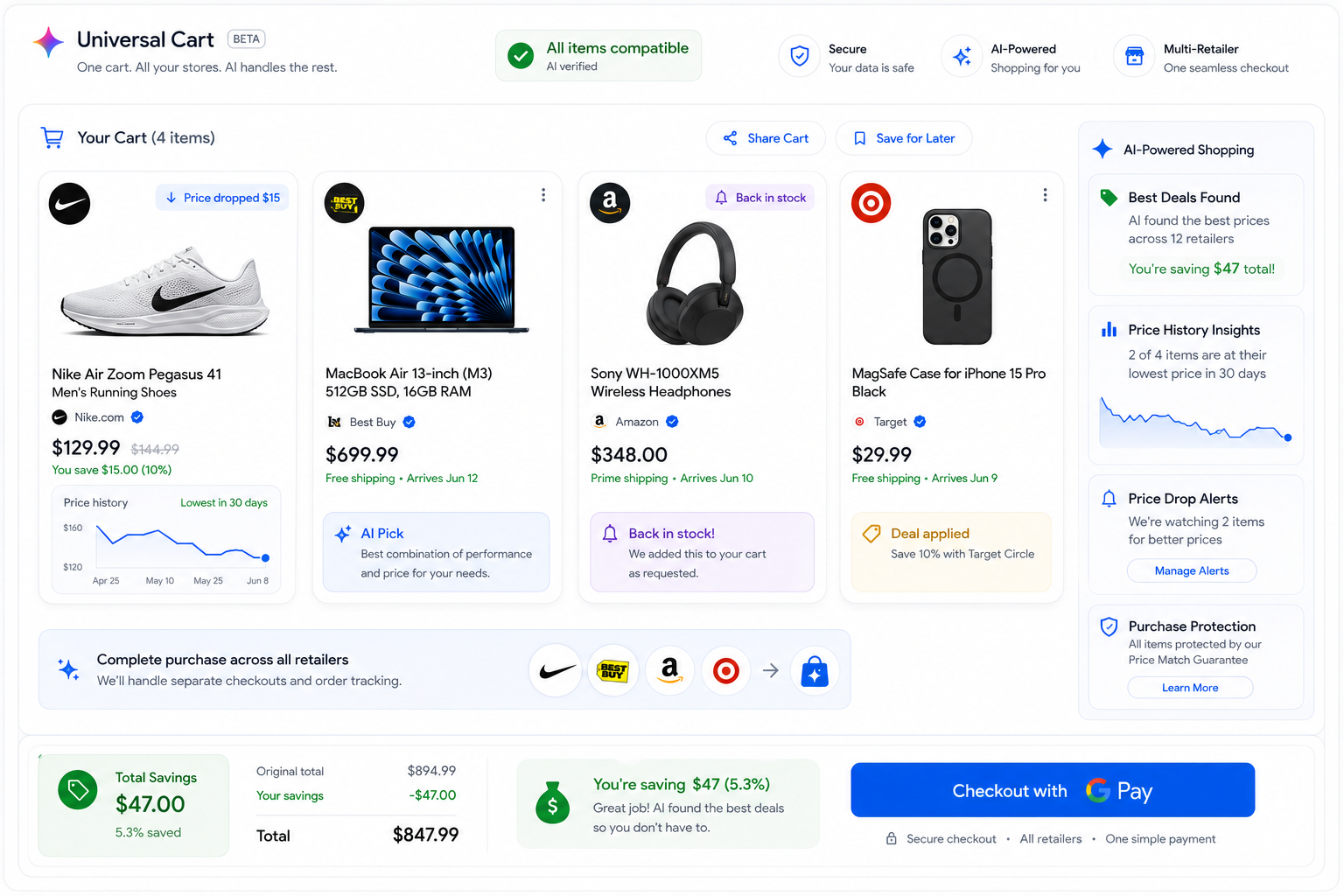
Google introduced Universal Cart, an AI-powered shopping hub that fundamentally changes how we purchase products online. Rather than maintaining separate carts across different retailers, Universal Cart provides a single persistent shopping basket that follows you across Google Search, the Gemini app, YouTube, Gmail, and participating merchant websites.
Powered by Gemini AI, Universal Cart actively monitors your saved items for price drops, tracks price history, sends back-in-stock alerts, and runs AI compatibility checks to ensure items work together. For complex purchases like building a custom PC with parts from multiple retailers, the cart validates compatibility before checkout.
Universal Commerce Protocol
Universal Cart is built on the Universal Commerce Protocol (UCP), an open standard Google released in January 2026. UCP creates a common language for AI-driven commerce, enabling seamless checkout directly through Google or handoff to a merchant’s own site while preserving customer loyalty benefits.
A March 2026 update to UCP added cart management capabilities, real-time catalog queries, and identity linking. Launch partners include major retailers: Nike, Sephora, Target, Ulta Beauty, Walmart, Wayfair, and Shopify merchants like Fenty and Steve Madden.
Agent Payments Protocol
Google also announced updates to its Agent Payments Protocol (AP2), which enables AI agents to make purchases autonomously on your behalf. You set guardrails: specify brands you prefer, products you want, and spending limits. When those conditions are met, the agent completes the purchase automatically.
AP2 integration with Google’s own products begins rolling out in summer 2026, giving Google unprecedented visibility into consumer shopping behavior from discovery through purchase.
Availability
Universal Cart rolled out to U.S. users through Google Search and the Gemini app in summer 2026, with YouTube and Gmail integrations following later in the year. UCP-powered checkout expands to Canada and Australia in the coming months, with the U.K. and additional markets planned.
Android XR and Intelligent Eyewear
The Return of Smart Glasses
More than a decade after Google Glass failed to gain mainstream adoption, Google is re-entering the smart glasses market with a radically different approach. At I/O 2026, Google and Samsung formally revealed their first generation of “Intelligent Eyewear” built on the Android XR platform.
Unlike Google Glass, which was an obvious tech product, Intelligent Eyewear emphasizes conventional aesthetics. Google partnered with established eyewear brands Gentle Monster and Warby Parker to create styles that look like regular glasses you’d wear every day.
Gentle Monster’s designs lean toward bold, fashion-forward profiles. Warby Parker’s versions are deliberately understated and classic. This split is intentional. Google is positioning smart glasses as a lifestyle category with multiple identities, not a single technology product.
Two Product Categories
Google announced two types of intelligent eyewear:
1. Audio-First Glasses (Launching Fall 2026)
- Built-in speakers, microphones, and cameras but no display
- Voice interaction with Gemini AI
- Contextual help, navigation, translation, and photography
- Designed as a companion to your smartphone for hands-free assistance
2. Display Glasses (Coming Later)
- In-lens display showing private information
- Turn-by-turn navigation and real-time translation captions
- Visual AR overlays for enhanced reality experiences
- More expensive but offers visual augmentation
Gemini-Powered Capabilities
Gemini AI functions as the operational core of Intelligent Eyewear. Users interact through voice prompts, touch gestures on the frame, and the embedded cameras and microphones.
Key features:
- Turn-by-turn navigation while keeping your hands free
- Summarized notifications for important messages
- Calendar management and reminders
- Real-time translation of text and speech
- Contextual recommendations based on your location
- Photography with AI enhancement
- Place orders at restaurants hands-free
Project Aura: Wired AR Glasses
Google also previewed Project Aura, wired AR glasses that connect to your phone or computer to provide a headset-like immersive experience in a more portable form factor.
Project Aura features a 70-degree field of view and optical see-through technology that layers digital content into your physical worldview. You can view recipes while cooking, see step-by-step repair guides while fixing appliances, or operate multiple work windows without blocking your surroundings.
Google indicated more details about Project Aura will be shared in 2026, but didn’t provide specific availability timelines.
Antigravity 2.0: The Agent-First Development Platform
Evolution of Antigravity
Google Antigravity originally launched in November 2025 as an AI-first IDE (integrated development environment) built on a VS Code fork. At I/O 2026, Google unveiled Antigravity 2.0, transforming it from a single coding tool into a comprehensive agent-first development platform.
Pichai emphasized that Google used Gemini 3.5 Flash with Antigravity internally to build the model itself, creating a powerful feedback loop: “The new model has been a game-changer for us internally at Google. We’ve been using 3.5 Flash with the reimagined version of our agent-first development platform, Antigravity. And it’s dramatically accelerated how we build.”
The Antigravity Ecosystem
Antigravity 2.0 expands across multiple surfaces:
1. Antigravity Desktop Application
A standalone desktop app (not an IDE extension) that serves as a central hub for agent orchestration. You can spin up multiple AI agents to execute tasks in parallel, create dynamic subagent workflows for complex operations, and schedule tasks to run automatically in the background.
The desktop app integrates directly with Google AI Studio, Android development tools, and Firebase, creating a unified development environment.
2. Antigravity CLI
A command-line interface built in Go for developers who prefer terminal-based workflows. It provides lightweight access to agent capabilities without running the full desktop application.
3. Antigravity SDK
A software development kit that gives developers the building blocks to create custom agents on top of Google’s infrastructure. Custom agent templates are available in AI Studio for enterprise use cases.
4. Managed Agents in Gemini API
A single API call can now spin up a full agent that reasons, uses tools, executes code, and maintains state across sessions. The agent runs in an isolated Linux container with persistent files and state, enabling seamless multi-turn agent sessions without manual environment management.
5. Native Android Building in AI Studio
AI Studio now supports building complete Android apps from a single prompt, with direct Google Play Console integration for publishing to the test track without leaving AI Studio.
Voice Support and Automation
Antigravity 2.0 includes native voice command support, allowing developers to control agents verbally. The platform also introduces scheduled tasks: define tasks that invoke agents automatically in the background, converting agents from single-turn tools into persistent automation pipelines.
Transition from Gemini CLI
Google confirmed that consumer access to Gemini CLI and Gemini Code Assist IDE extensions will end on June 18, 2026, for AI Pro, AI Ultra, and free-tier users. Enterprise customers on Gemini Code Assist Standard or Enterprise licenses will retain access. The message is clear: Antigravity is Google’s future for AI-assisted development.
The SEO Earthquake: Impact on Publishers and Websites
The Fundamental Value Exchange Is Changing
Google I/O 2026 announcements accelerate a trend that has been building for over a year: the shift from sending users to websites to answering questions directly within Google’s AI-powered interfaces.
When AI Overviews first rolled out to all U.S. users in May 2024, publishers immediately reported traffic declines. DMG Media, which owns MailOnline and Metro, documented drops of nearly 90% for certain searches. An analysis by Digital Content Next found a 10% overall search traffic decline among member publishers between May and June 2024, representing millions of lost visits.
The I/O 2026 announcements—especially information agents, generative UI, and agentic search—will likely accelerate this trend. When Google’s AI can synthesize information, build interactive tools, and dispatch background agents to track changes, the incentive for users to click through to source websites diminishes dramatically.
Which Content Types Are Most Affected
Research from 2025-2026 shows clear patterns in which content faces the highest exposure:
High Impact:
- Informational queries (“what is,” “how to”) – AI Overviews directly answer these
- Health information sites – 51.6% AI Overview rate for health queries
- Recipe sites – AI Overviews answer cooking questions directly
- News publishers – major declines reported in Google Discover traffic
- Quick-answer content (definitions, conversions, basic facts)
Lower Impact:
- Transactional content – purchase intent still drives clicks
- In-depth analysis and opinion – unique perspectives less replaceable
- Entertainment content – users seek the experience, not just information
- Niche expertise – highly specialized content harder for AI to replicate
The Citation Opportunity:
Pages cited within AI Overviews can actually see click-through rate increases of up to 35%. Being the source Google cites provides significant visibility advantage. This creates a new SEO optimization goal: earn citations in AI-generated answers rather than traditional #1 rankings.
The Rise of Generative Engine Optimization
A new discipline called Generative Engine Optimization (GEO) emerged in 2025-2026, focusing on optimizing content for AI-generated search experiences rather than traditional rankings.
Key GEO strategies:
- Create comprehensive, authoritative content that AI systems want to cite
- Structure information clearly with strong semantic markup
- Build expertise, authority, and trust (E-E-A-T) signals
- Provide unique data, research, or perspectives AI can’t generate
- Optimize for entity recognition and knowledge graph inclusion
- Focus on context-rich content that helps AI understand meaning
What Publishers Should Do Now
1. Diversify Traffic Sources
Google Search should no longer be your primary traffic driver. Invest in email lists, social media communities, direct traffic, and alternative discovery platforms.
2. Build Direct Relationships
Focus on building loyalty with your audience. If AI can answer basic questions, your value is in unique perspectives, community, and experiences that can’t be replicated.
3. Optimize for Citations
If you can’t beat AI Overviews, get cited by them. Be the authoritative source that AI systems reference. Pages earning citations maintain and even increase visibility.
4. Create Experiences, Not Just Information
Interactive tools, calculators, personalized recommendations, community features—these create value AI can’t simply replicate in an overview.
5. Monitor and Adapt Continuously
The AI search landscape evolves rapidly. Track which queries trigger AI Overviews, which content gets cited, and where traditional search results still dominate. Adapt your strategy accordingly.
Regulatory Concerns
The European Union is closely watching these developments. In April 2026, the European Commission published measures requiring Google to share anonymized search data with rival search engines and AI providers under the Digital Markets Act, with a compliance deadline of July 27, 2026.
The more Google’s search interface resembles a self-contained AI application rather than a portal to the web, the sharper the regulatory scrutiny becomes. Publishers and governments worldwide are questioning whether this model is sustainable or fair.
The Future of Search: AI vs. Traditional Models
The Competitive Landscape
Google’s I/O 2026 announcements don’t exist in a vacuum. The company is racing against formidable competitors:
OpenAI:
ChatGPT has become a search destination for millions. OpenAI continues expanding capabilities with web browsing, real-time information, and its own form of agentic workflows.
Microsoft Copilot:
Integrated across Windows, Edge, Office, and Bing, Microsoft’s AI assistant benefits from deep OS-level integration Google can’t match on most devices.
Perplexity:
A pure AI-first search engine that never pretended to be traditional search, building a loyal user base seeking synthesized answers with citations.
Apple:
While not directly competitive in search, Apple’s integration of AI across iOS and its devices creates an alternative gateway to information that bypasses Google entirely.
What Differentiates Google
Google’s advantages in this race are substantial:
- Scale: Over a billion searches daily, creating an unmatched data flywheel
- Knowledge Graph: Decades of structured knowledge about entities and relationships
- Integration: Gmail, Maps, YouTube, Calendar, Photos—the ecosystem lock-in is powerful
- Infrastructure: Custom TPU chips and massive computing resources
- Real-time data: Shopping Graph with 60+ billion product listings, fresh news, live sports
No competitor can match this combination. However, Google also carries legacy constraints: user expectations, regulatory scrutiny, advertiser relationships, and the need to maintain traditional search while transforming it.
The Vision: Search as an Agent Platform
Liz Reid, Google’s VP of Search, articulated the vision on stage at I/O: “We believe AI will be the most powerful engine for discovery that the web has ever seen.”
The future Google envisions isn’t search as we’ve known it. It’s an agent platform where you:
- Describe problems in natural language, not keywords
- Deploy specialized agents to monitor, research, and act on your behalf
- Receive synthesized intelligence rather than raw links
- Complete tasks end-to-end without leaving Google’s ecosystem
- Interact through voice, text, images, and eventually ambient computing devices
This isn’t incremental improvement. It’s a complete reimagining of what search means. The question is whether users, publishers, regulators, and the broader web ecosystem will accept this transformation.
Key Takeaways: What Google I/O 2026 Means for You
For Everyday Users
- AI is becoming proactive, not reactive. Agents will work continuously on your behalf
- Search will feel more like conversation than keyword matching
- Video creation becomes accessible to everyone through Gemini Omni
- Smart glasses may finally become practical and fashionable
- Shopping gets smarter with Universal Cart tracking deals and ensuring compatibility
For Developers
- Gemini 3.5 Flash delivers frontier performance at Flash-tier costs
- Antigravity 2.0 transforms development with multi-agent workflows
- Building Android apps becomes as simple as describing them in AI Studio
- MCP support enables integration across the entire software ecosystem
- Agent orchestration becomes a core development skill
For Marketers and SEO Professionals
- Traditional SEO evolves into Generative Engine Optimization (GEO)
- Citations in AI Overviews become more valuable than #1 rankings
- Information agents change how you need to maintain brand visibility
- E-commerce shifts toward AI-mediated discovery and Universal Cart
- Content strategy must account for AI synthesis, not just rankings
For Publishers and Content Creators
- Google Search traffic will continue declining for informational content
- Diversifying traffic sources is no longer optional
- Becoming a cited source in AI answers is the new optimization goal
- Creating unique experiences becomes more valuable than basic information
- Direct audience relationships matter more than ever
For Business Leaders
- Agentic AI isn’t future speculation—it’s available now
- Cost efficiencies from Gemini 3.5 Flash are substantial
- Agent governance and IAM policies need immediate attention
- Universal Commerce Protocol creates new e-commerce opportunities
- The ambient computing layer (glasses, agents, voice) is emerging now
Conclusion: The Agentic Era Has Arrived
Google I/O 2026 will be remembered as the moment AI fully crossed the threshold from assistant to agent. For nearly two years, we’ve watched AI capabilities accelerate at a breathtaking pace. But most implementations remained reactive: you ask, the AI answers. Your prompt, the AI generates. You command, the AI executes.
That paradigm ended on May 19, 2026. With Gemini Spark working 24/7 in the cloud, information agents monitoring the web continuously, Universal Cart tracking deals autonomously, and Antigravity orchestrating multi-agent development workflows, Google demonstrated that agentic AI isn’t a research project. It’s production-ready and rolling out to billions.
The implications ripple across every industry. Search engines become discovery platforms. E-commerce becomes AI-mediated. Content creation becomes conversational. Software development becomes agent-orchestrated. And our relationship with information fundamentally transforms from pull to push, from searching to being served.
For those who adapt quickly, this creates extraordinary opportunities. Early movers in Generative Engine Optimization will capture disproportionate visibility. Businesses that integrate Universal Commerce Protocol will tap into Google’s vast shopping graph. Developers who master agent orchestration will build the next generation of applications.
But adaptation comes with challenges. Publishers face existential questions about traffic and monetization. Regulators grapple with market concentration and fair competition. Users must navigate questions of privacy, autonomy, and how much they want AI acting on their behalf.
Google is betting its future on one thesis: that AI agents will create more value than traditional search ever did. That thesis assumes users want proactive AI, that businesses will embrace AI-mediated commerce, that developers will adopt agent-first workflows, and that regulators will allow this transformation.
Whether Google is right will determine not just the company’s trajectory, but the structure of the internet itself. Because if this vision succeeds, the web becomes less a network of destinations and more a dataset for AI agents to synthesize, reason across, and act upon.
The only certainty is that we’re witnessing a fundamental shift. Google I/O 2026 wasn’t just another product announcement. It was the opening salvo of the agentic era. The race is on, the stakes are enormous, and the winners will be those who understand that AI is no longer a tool you use—it’s an agent that works for you.
Frequently Asked Questions
Q: When were these Google I/O 2026 announcements made?
A: Google I/O 2026 took place on May 19-20, 2026, at the Shoreline Amphitheatre in Mountain View, California. Most major announcements came during CEO Sundar Pichai’s opening keynote on May 19.
Q: What is the difference between Gemini 3.5 Flash and Gemini 3.5 Pro?
A: Gemini 3.5 Flash is optimized for speed and cost, delivering frontier performance at 4x the speed and 40% lower cost than Gemini 3.1 Pro. It’s ideal for most real-world applications. Gemini 3.5 Pro (coming in June 2026) is designed for the most challenging reasoning tasks and long-context understanding that require maximum capability.
Q: How much does Gemini Spark cost?
A: Gemini Spark is included in the Google AI Ultra tier, which costs $100 per month. It’s designed for power users, developers, and creators who need advanced capabilities and higher usage limits.
Q: What are information agents in Google Search?
A: Information agents are AI-powered background processes that monitor the web continuously on your behalf. You set them up with specific criteria (like apartment hunting requirements or stock market interests), and they work 24/7 to find relevant updates, synthesize information, and alert you when something meaningful changes.
Q: Can I use Gemini Omni for free?
A: Gemini Omni Flash is available to Google AI Plus, Pro, and Ultra subscribers through the Gemini app. However, you can also access it for free through YouTube Shorts and YouTube Create if you want to create and share videos publicly.
Q: When will Android XR smart glasses be available?
A: The audio-first Android XR glasses from Gentle Monster and Warby Parker are launching in Fall 2026. Display glasses with visual AR capabilities will come later, though Google hasn’t announced specific timing.
Q: How will Google’s changes affect my website’s SEO?
A: The shift toward AI-powered search will likely reduce traditional website traffic, especially for informational queries. However, sites that get cited in AI Overviews can see CTR increases of up to 35%. Focus on becoming an authoritative source, optimizing for citations, and diversifying traffic sources beyond Google Search.
Q: What is Universal Cart?
A: Universal Cart is an AI-powered shopping hub that maintains a single persistent cart across Google Search, Gemini, YouTube, Gmail, and participating retailers. It actively monitors prices, tracks deals, sends restock alerts, and checks product compatibility. It rolled out to U.S. users in summer 2026.
Q: Is Antigravity 2.0 replacing all Google coding tools?
A: Yes, for consumer users. Google is ending consumer access to Gemini CLI and Gemini Code Assist IDE extensions on June 18, 2026. Antigravity 2.0 is Google’s unified platform for AI-assisted development going forward. Enterprise customers on Code Assist Standard or Enterprise licenses retain access to those tools.
Q: How does Google ensure AI-generated content is identified?
A: Google uses SynthID, a digital watermarking technology embedded deeply in generated content that survives editing, compression, and social media uploads. They’re also implementing C2PA Content Credentials to track content provenance. These systems are expanding across Gemini, Search, and Chrome.
Ready to Adapt to the AI-Powered Future?
The landscape of search, content discovery, and digital interaction has fundamentally changed. Whether you’re a business owner, marketer, developer, or content creator, understanding and adapting to these shifts isn’t optional—it’s essential for staying competitive.
Start by evaluating how Google’s AI transformations affect your current digital strategy. Are you optimized for AI citations? Have you diversified your traffic sources? Are you building experiences that AI can’t replicate?
The agentic era has arrived. The question is: are you ready to thrive in it?
Subscribe to stay updated on the latest AI developments, SEO strategies, and digital transformation insights.
Authority Sources

Pooja Thakkar is a passionate content writer at DengoWeb, where she crafts engaging and SEO-friendly content tailored to the digital world. With a keen eye for detail and a love for storytelling, she specializes in creating blogs, web copy, and marketing content that drives traffic and builds brand authority. When she’s not writing, Pooja loves exploring the latest trends in tech and digital marketing to bring fresh ideas to every piece she creates.