Quick Summary
|
Why This Moment Matters
|
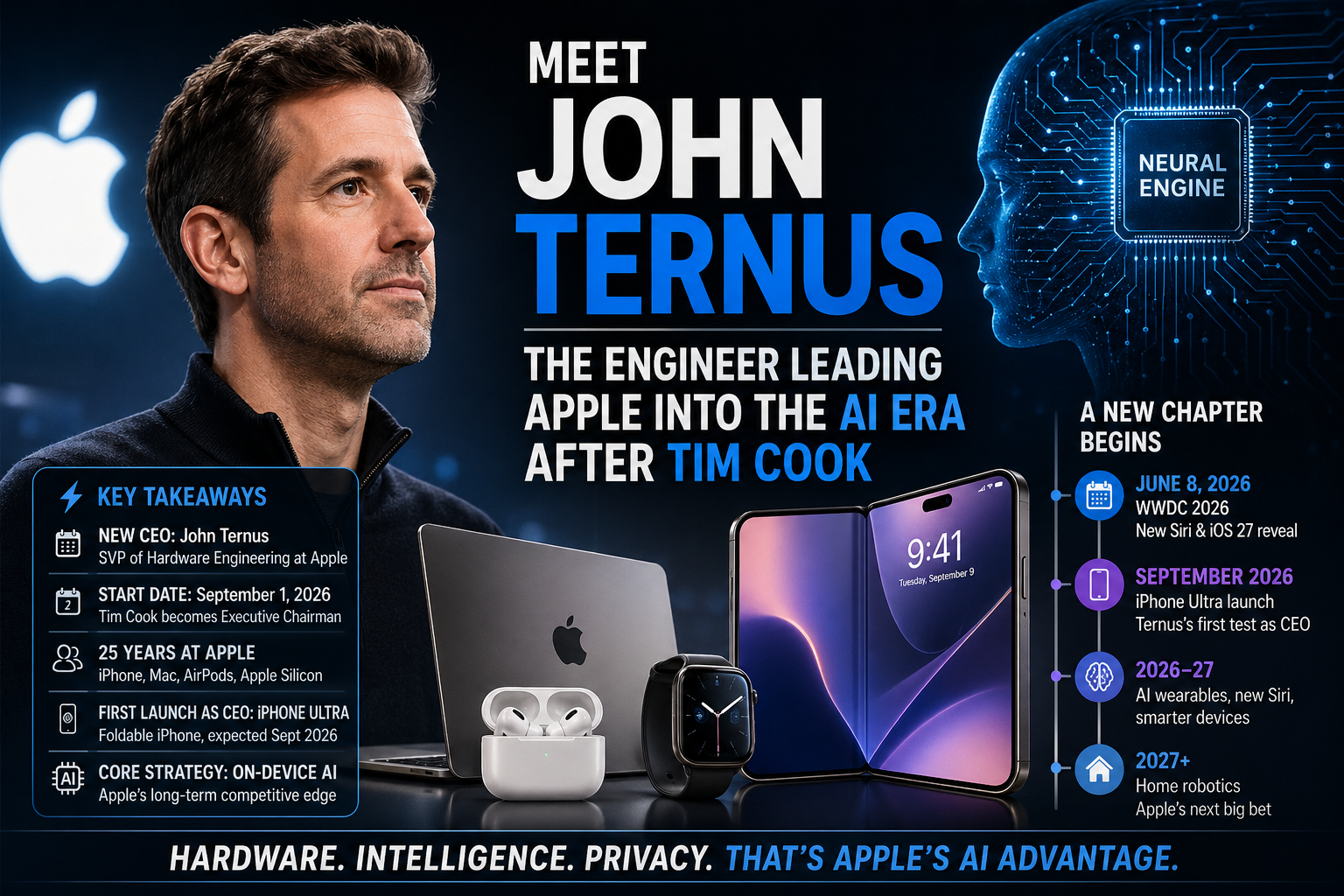
Apple just handed the keys to the most valuable company on Earth to a man most of the world had never heard of. On April 20, 2026, Apple announced that John Ternus — the new Apple CEO and 25-year hardware engineering veteran — will take over from Tim Cook effective September 1, 2026. Cook, who led Apple since Steve Jobs died in 2011, will become Executive Chairman of the Board.
It is the most significant leadership transition Apple has seen since Cook took the helm 15 years ago. And it arrives at a turbulent moment: artificial intelligence is rewriting the rules of personal technology — and Apple finds itself further behind in the AI race than investors are comfortable with.
So who is John Ternus? Why did Apple’s board choose a hardware engineer over a software leader or AI specialist? And what challenges await him on September 1?
Who Is John Ternus? The New Apple CEO Explained
| Q: Who is John Ternus and why is he Apple’s new CEO?
John Ternus (born 1975/76) is Apple’s incoming CEO, effective September 1, 2026. He spent 25 years at Apple as SVP of Hardware Engineering, leading iPhone, Mac, iPad, AirPods, Apple Watch, and Apple Silicon. Apple’s board chose him because his hardware-first approach aligns with Apple’s AI strategy of building intelligence directly into devices — rather than relying on cloud models. |
John Ternus is not a flashy Silicon Valley personality. He is not a Steve Jobs-style visionary. He is, at his core, a builder — someone who has spent his entire career turning ambitious ideas into physical products that billions of people actually use.
Ternus graduated with a mechanical engineering degree from the University of Pennsylvania in 1997. His senior project — a head-movement-controlled feeding arm for people with quadriplegia — already showed the human-centred thinking that would define his career. After four years designing VR headsets at Virtual Research Systems, he joined Apple in 2001.
John Ternus Career Timeline at Apple
- 2001 — Joined Apple; first project: Apple Cinema Display
- 2013 — VP of Hardware Engineering: iPad, Mac, AirPods
- 2020 — Added iPhone hardware engineering to his scope
- 2021 — SVP of Hardware Engineering (Apple’s top hardware role); joined executive team
- April 2026 — Named CEO-designate by Apple’s board, succeeding Tim Cook
Inside Apple, Ternus is described as charismatic and well-liked — a leader who turned down a private office upon promotion to remain sitting with his engineering team. Bloomberg’s Mark Gurman called him Apple’s “most likely heir apparent” long before the announcement.
| “John Ternus has the mind of an engineer, the soul of an innovator, and the heart to lead with integrity and with honor.”
— Tim Cook, outgoing Apple CEO (Apple Newsroom, April 20, 2026) |
The Products That Made John Ternus Apple’s Next CEO
His hardware resume is Apple’s greatest hits of the past decade — and the reason the board trusted him with the top job.
Apple Silicon — The Most Important Hardware Bet in Apple’s Modern History
In 2020, Apple abandoned Intel entirely and built its own M-series chips. This required redesigning Mac logic boards, cooling systems, memory architecture, and manufacturing from scratch. The result: MacBook Air became the fastest, quietest Mac ever made. Mac Studio created a new product category. Apple gained complete control over performance, battery life, and on-device machine learning. Ternus led all the hardware engineering that made this possible.
AirPods — A $100 Billion Market Apple Created From Zero
AirPods launched in 2016 to widespread mockery. By 2026, the global wireless earbuds market exceeds $100 billion annually — a category Apple essentially invented. Ternus oversaw every generation of AirPods hardware, including the move to custom Apple silicon inside the earbuds themselves.
iPhone Ultra — His First Test as CEO
Multiple credible sources — including Bloomberg’s Mark Gurman and analyst Ming-Chi Kuo — report that Apple will launch its first-ever foldable iPhone, expected to be called the iPhone Ultra, in September 2026. The book-style device is reported to feature a 7.7-inch internal display, dual 48MP cameras, the A20 chip, Touch ID, and a starting price of around $1,999. This will be Ternus’s opening product statement as CEO — Apple has not officially confirmed the device as of publication.
What Tim Cook Built — And the AI Gap He’s Leaving
| Q: Why did Tim Cook step down as Apple CEO?
Tim Cook did not step down under pressure. Apple described the move as a ‘thoughtful, long-term succession planning process’ approved unanimously by the board. After 15 years and growing Apple from $350B to $4 trillion in market cap, Cook (65) transitions to Executive Chairman while Ternus (50) takes over for the next decade. |
Tim Cook grew Apple from a $350 billion company in 2011 to a $4 trillion company in 2026. He expanded services revenue from near-zero to over $100 billion annually, built Apple Watch and AirPods into a wearables empire, and delivered one of the most financially successful corporate tenures in history.
But the AI era revealed a serious strategic blind spot. When ChatGPT launched in late 2022 and ignited the global AI race, Apple was caught unprepared. Apple Intelligence features were delayed repeatedly. AI chief John Giannandrea was replaced in early 2026 by Amar Subramanya, a former Microsoft AI leader.
Then came the clearest admission yet. In January 2026, Apple and Google published an official joint statement confirming a multi-year collaboration: Apple’s next-generation Foundation Models — the AI backbone powering Siri — will be built using Google’s Gemini technology. Google Cloud CEO Thomas Kurian reconfirmed this at Google Cloud Next 2026, stating Gemini will power a more personalised Siri arriving later in 2026 — likely with iOS 27 at WWDC on June 8.
This is what Ternus inherits: a $4 trillion company with extraordinary hardware, a dominant iPhone, thriving services — and an AI strategy being rebuilt from the ground up with a competitor’s technology.
The 5 Biggest Challenges Waiting for John Ternus
| # | Challenge | What It Means |
|---|---|---|
| 1 | Fixing Apple’s AI Strategy | Apple confirmed a Gemini partnership but still has no proprietary LLM. Ternus must decide: build in-house, deepen Google deal, or go hybrid. |
| 2 | iPhone Ultra Launch | Ternus’s debut product moment as CEO. Reports point to a $1,999+ foldable with 7.7-inch display — it must justify every cent of that premium. |
| 3 | Post-iPhone Strategy | Smart glasses, AI pendants, home robots — Ternus must choose Apple’s next decade-defining bet beyond the iPhone. |
| 4 | Tariffs & Supply Chain | ~75% of iPhones manufactured in China; 25% shifting to India. US-China trade tension demands executive experience Ternus is still developing. |
| 5 | Executive Team Stability | Multiple senior exits under Cook. New AI lead Amar Subramanya must be quickly integrated. Ternus needs his team stable before WWDC. |
The Opportunity vs The Risk
| ✅ Opportunities | ⚠️ Risks |
|---|---|
|
|
Why Did Apple Choose a Hardware CEO for the AI Era?
| Q: Why did Apple pick a hardware engineer as CEO instead of an AI expert?
Apple’s AI strategy is different from Google’s or Microsoft’s. Apple doesn’t want to win by building the biggest AI model — it wants to win by building the best device. On-device AI running on Apple Silicon chips is faster, more private, and works without internet. That requires a hardware engineer who understands chips, sensors, neural engines, and device physics — which is exactly John Ternus’s expertise. |
Apple’s approach to AI is fundamentally different from every major rival. While Google, Microsoft, Meta, and Amazon spend hundreds of billions on cloud infrastructure and large language models, Apple is betting on on-device AI — running intelligence directly on the chips inside your iPhone, Mac, Apple Watch, and earbuds.
Apple has embedded Neural Engine chips — dedicated machine learning silicon — into its devices since 2017. Apple’s M-series and A-series chips are among the most capable on-device AI processors ever built. When AI runs on your device, it is faster, more private, and functions without a network connection — a genuine competitive advantage over cloud-dependent rivals.
Apple’s board made a deliberate bet: in the AI era, the device is not just a container for software — the device is the AI experience. And no one at Apple knows how to build the device better than John Ternus.
What Ternus Is Building — Apple’s AI Product Roadmap
- AI Wearables (2026–27): Smart glasses competing with Meta Ray-Bans; AI pendant with camera and speaker; next-gen AirPods with spatial-awareness cameras
- iPhone Ultra (Sept 2026): Apple’s biggest iPhone form-factor change since 2007 — Ternus’s opening statement as CEO
- New Siri App (2026): A standalone chatbot-style Siri powered by Gemini, expected at WWDC June 8
- Home Robotics (2027+): Tabletop smart hub with robotic arm; mobile home robots in active research
- Touchscreen MacBook Pro: New Mac form factors extending Apple Silicon into fresh product categories
Apple vs Competitors: AI Strategy Comparison 2026
| Company | AI Strategy | Key Advantage |
|---|---|---|
| Apple | On-device AI + Gemini partnership | Privacy, hardware depth, Neural Engine |
| Cloud AI (Gemini) + Android ecosystem | Most capable models; powers Siri too | |
| Microsoft | Azure AI + OpenAI partnership | Enterprise dominance, Copilot in Office |
| Meta | Open-source LLaMA + Ray-Ban AI glasses | Social reach + wearables distribution |
What to Watch: Key Apple Dates in 2026
- June 8, 2026 — WWDC 2026: First reveal of new Gemini-powered Siri and iOS 27
- September 2026 — iPhone Ultra launch: Ternus’s first major product debut as CEO
- September 2026 — iOS 27 public release: Enhanced Apple Intelligence goes live
- Late 2026 — AI wearables announcements: Smart glasses, AI pendant, upgraded AirPods
- 2027 — Home robotics debut: Apple’s long-term bet on AI in the home
The Bottom Line: What John Ternus Means for Apple’s Future
John Ternus as Apple CEO means one thing above all: Apple is doubling down on hardware as the foundation of its AI strategy. He inherits a $4 trillion company with world-class engineering, a dominant iPhone business, and thriving services — but an AI strategy being rebuilt from scratch with Google’s help.
His first real tests come fast. The iPhone Ultra in September will reveal whether Apple can charge $2,000 for a new form factor and make the world want it. The Gemini-powered Siri at WWDC in June will show whether Apple can finally close the gap on ChatGPT, Gemini, and Claude.
The AI era will not be won by the company with the biggest model. It will be won by the company that puts the best AI experience in your pocket, on your wrist, and in your ears. If John Ternus is right about that — and if Apple executes — this could look, in hindsight, like exactly the right bet at exactly the right moment.
| “Apple doesn’t just need a new CEO — it needs a new answer to the AI era. And now, that answer rests on John Ternus.” |
Quick Answers: John Ternus & Apple AI
Q: Who is replacing Tim Cook as Apple CEO?
John Ternus, Apple’s Senior VP of Hardware Engineering, is replacing Tim Cook as Apple CEO effective September 1, 2026. Cook becomes Executive Chairman. Ternus, aged 50, joined Apple in 2001 and led hardware engineering for iPhone, Mac, iPad, AirPods, Apple Watch, and Apple Vision Pro for 25 years.
Q: Is Apple using Google Gemini to power Siri?
Yes — confirmed. Apple and Google published an official joint statement in January 2026 confirming a multi-year collaboration: Apple’s next-generation Foundation Models will be built using Google’s Gemini technology. Google Cloud CEO Thomas Kurian publicly reconfirmed this at Google Cloud Next 2026. A Gemini-powered Siri is expected to launch with iOS 27, with a first reveal at WWDC on June 8, 2026.
Q: What is Apple’s AI strategy under John Ternus?
Apple’s AI strategy focuses on on-device AI — running intelligence directly on Apple Silicon chips in iPhones, Macs, and wearables — rather than relying on cloud servers. In the short term, Apple has partnered with Google Gemini to power a revamped Siri. Ternus is expected to accelerate AI wearables including smart glasses, an AI pendant, and upgraded AirPods.
Q: Will Apple release a foldable iPhone in 2026?
Reports from Bloomberg’s Mark Gurman, analyst Ming-Chi Kuo, and multiple supply-chain sources indicate Apple’s first foldable iPhone — expected to be called iPhone Ultra — will launch in September 2026. It is reported to feature a 7.7-inch internal display, dual 48MP cameras, A20 chip, and a starting price of approximately $1,999. Apple has not officially confirmed the device.
Q: What products will John Ternus launch as Apple CEO?
John Ternus’s expected product launches as Apple CEO include: the iPhone Ultra (foldable iPhone, September 2026), a redesigned Gemini-powered Siri with iOS 27 (revealed at WWDC June 8, 2026), AI smart glasses, an AI wearable pendant, upgraded AirPods with spatial cameras, and longer-term, home robotics devices. A touchscreen MacBook Pro is also reportedly in development.
Also read: $40B AI Deal: Why Google Is Betting Big on Anthropic

Pooja Thakkar is a passionate content writer at DengoWeb, where she crafts engaging and SEO-friendly content tailored to the digital world. With a keen eye for detail and a love for storytelling, she specializes in creating blogs, web copy, and marketing content that drives traffic and builds brand authority. When she’s not writing, Pooja loves exploring the latest trends in tech and digital marketing to bring fresh ideas to every piece she creates.